Does the model suit your lighting task?
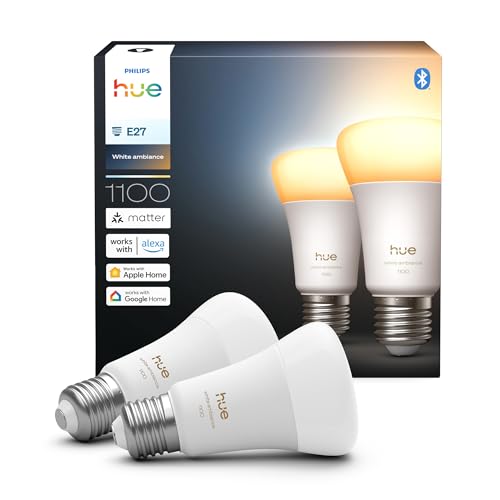
Philips Hue White Ambiance A60 E27 2-pack, 1100 lm at 8.1 W, class D stands in this selection for E27 lamp holders with smart white colour temperature, no colour mode and a borderline energy efficiency class D. That is a narrower and more honest statement than a blanket “good” or “bad”. A lamp can be technically decent and still disappoint in the wrong place. That is why this analysis starts with the intended use, not with a score.
The decisive figure is the luminous efficacy: 1100 lumens divided by 8.1 watts is 135.8 lumens per watt, factor 1.000 for non-directional and mains-operated, class D according to the register. The luminous flux applies at 4000 kelvin according to the manufacturer.
For this model there are 5 readable product features from the Amazon listing. They are not presented as independently confirmed measured values. We explicitly separate what the source states from our practical assessment. We do not claim any long-term, laboratory or room trials of our own. We reproduce the quoted listing texts unchanged in content, but apply the house style for punctuation: dashes become a colon or comma, ranges are written out with “to”, and special characters and advertising symbols are removed. Numbers, units and statements are left untouched.
Product data and sources
| Product | Philips Hue White Ambiance A60 E27 2-pack, 1100 lm at 8.1 W, class D |
|---|---|
| Brand | Philips Hue |
| Category | Home lighting |
| ASIN | B0FJ8V2TCG |
| Sources as of | 2 November 2026 |
| Type of research | Data and source analysis; no laboratory or long-term trial of our own |
Listing claim: Natural daylight, The smart lamp has a…
What the source says: Natural daylight, The smart lamp has an above-average CCT range that covers the entire spectrum of daylight: relaxing tones below 2,700K, blue sky light at 12,000K and invigorating white light at 17,000K
Why this matters: The stated colour temperature describes the effect, not the brightness. In everyday use it matters whether fixed steps or a continuous range are offered and whether the setting is saved.
Listing statement: Ultra-low dimming, Dim your LED light smoothly…
What the source states: Ultra-low dimming, Dim your LED light smoothly from full brightness down to 0.2 % to achieve the right illuminance, whether you are watching a film on the sofa or want to relax before going to sleep
Why this matters: This product is dimmed via the app, hub or wireless switch, not via a wall dimmer switch. A dimmer switch upstream in the circuit must be bypassed or replaced, otherwise the light flickers or the wireless connection drops.
Listing statement: Smart control, Control your LED lighting…
What the source states: Smart control, Control your LED lighting remotely with the award-winning Hue app or add a Hue Bridge to control it with your preferred home assistant, compatible with Alexa, Google Assistant and Apple Home
Why this matters: The system information should be matched against your existing smart home. Basic functions and manufacturer-specific effects are not automatically equally available on every platform. According to the manufacturer's page, the bridge is required for voice assistants. The lamp itself communicates via Bluetooth and Zigbee. Whether app control without a bridge is enough in daily use depends on the number of lamps and rooms.
Listing statement: Easy installation, Simply screw in your new…
What the source states: Easy installation, Simply screw in your new LED lamps, download the award-winning Hue app and benefit straight away from the advantages of smart lighting!
Why this matters: The system detail should be matched against your existing smart home. Basic functions and manufacturer-specific effects are not automatically available in the same way on every platform.
Listing statement: Long lifetime, These Hue LED light bulbs are…
What the source states: Long lifetime, These Hue LED light bulbs are made from the highest-quality materials and have an average lifetime of 25,000 hours.
Why this matters: This point should be matched against dimensions, instructions and the existing installation before buying. A listing can contain variants or shortened wording. The manufacturer's page gives 25,000 as the rated lifetime and 50,000 switching cycles. The register does not list an hours figure but lumen maintenance of 0.96 and a survival rate of 0.9. A verified number of hours cannot be read from that.
Use in daily life
In daily use, what counts is the E27 holder, an overall height of about 110 millimetres and that the wall switch stays on. The lamps are screwed in, and no separate place for a hub is needed.
For this model, the purchase decision should therefore hinge on a concrete situation. Before buying, write a sentence such as: “I need light for …” and add place, time of day and activity. If the model does not clearly fulfil this task, an alternative from the same category is probably the better choice.
The pair is not a colour lamp and no substitute for a light application recommended by a doctor. Light therapy does not replace medical treatment.
Strengths and limits of the assessment
What speaks for the model
- Product image, ASIN and listing data are clearly linked to one another.
- The design can be assigned to a specific lighting task: for E27 lamp holders with smart white colour temperature, no colour mode and a borderline energy efficiency class D.
- The available features allow a targeted check before buying, without inventing a star rating.
What remains open
- No long-term use of our own, no light measurement and no documented load check.
- Listing details can be abbreviated or change with variants and model updates.
- Room effect, glare and ease of use depend on your location and daily routine.
The purchase typically fails on expectation: the lamp is white, not coloured, and the extreme values of the range are hardly usable. Added to that is a wall switch that stays switched off, or a third-party dimmer in the circuit. In enclosed luminaires heat can play a role, but no data is available on this.
What you should measure and check before buying
Check the holder (E27) and the overall height of about 110 millimetres in your luminaire. Clarify whether you want voice control, because the manufacturer requires the bridge for it. Check whether a dimmer sits in the circuit, and leave the wall switch on permanently.
- Clarify the need: Clarify whether you want white or coloured light and whether you need voice control. Those are two different classes of lamp.
- Check the holder: E27 and about 110 millimetres of overall height must fit in the luminaire.
- Calculate the efficiency: 1100 lumens divided by 8.1 watts, factor 1.000, gives 135.8 lumens per watt, class D.
- Plan the control: According to the manufacturer, Bluetooth and Zigbee, with the bridge for voice assistants.
- Check the variant: Look for model 1100, 2-pack, EAN 8720169364868 and model identifier 9290038549A.
If you are unsure how much light your room needs at all, work it out once: the lumens-to-watts chart translates wattage figures into actual brightness, and how many lumens per room are needed depends on area and activity. Further models from this area are in the overview under home lighting, and the lighting calculator translates your room into a concrete target brightness.
Set-up, position and first check
When setting up, what counts is the holder, a switch that stays on permanently, the decision for or against the bridge and a look at dimmers in the circuit.
After set-up, do not judge the light only in daylight. In the evening, switch the rest of the lighting as you normally use it, and check the situation from seated, standing and walking height. Only then do disturbing reflections, hard shadows or an unfavourable switch position become visible.
Keep the instructions and the model designation. That helps with a new app setup, with firmware questions and in a guarantee claim. Light bulb and lamp holder remain interchangeable, so a later change of brightness or colour temperature is possible. This device is intended for indoor use only and is not approved for damp rooms or outdoor use.
Comparison with similar models
The comparison does not name winners. It shows models of the same category so that you can see whether one of them is closer to your lighting task. If two models have the same task in the Assessment column, they do not differ in purpose but in design, dimensions and features. The column then states what is actually different according to the sources.
| Model | Brand | Assessment | Details |
|---|---|---|---|
| Philips Hue White Ambiance A60 E27 2-pack | Philips Hue | for E27 lamp holders with smart white colour temperature, without a colour mode and with a tight energy efficiency class D | This review |
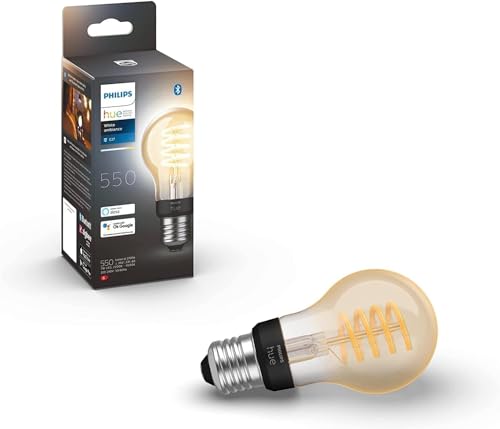
| Philips Hue E27 Filament A60 White Ambiance lamp, 550 lm, 7 W | Philips Hue | for existing E27 lamps in the Hue system, with an adjustable white tone from 2200 to 4500 kelvin, but only Class G and no documented dimming on a wall-switch dimmer | Read the review |
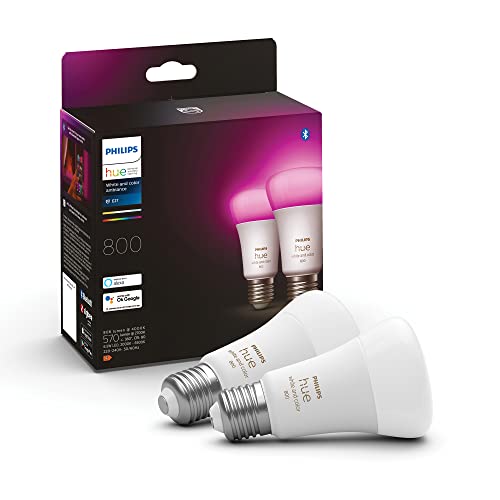
| Philips Hue E27 White & Color Ambiance, 806 lm, 2-pack | Philips Hue | for existing E27 lamps with colour and white light control by app, without a wall-switch dimmer and with an unclear model year in the listing | Read the analysis |
Our buying decision
Philips Hue White Ambiance A60 E27 2-pack, 1100 lm at 8.1 W, class D makes sense if you are looking for a pair of lamps for E27 lamp holders with smart white colour temperature, no colour mode and a borderline energy efficiency class D, have checked the dimensions at the intended spot and actually use the functions named in the listing. The purchase is less convincing if you expect a universal solution for several conflicting lighting tasks.
Keep looking if key data such as dimensions, light output, IP rating or compatibility is not clearly documented for your intended use. The same applies if you only like the look of the design, but the cable, the floor space or the controls would get in your way in daily use.
We deliberately award no stars. A numerical score would suggest a measurement accuracy that does not exist without documented hands-on testing. The statement this page can support is narrower: which details are available, what the model may be suited for, and which questions remain open before you buy?
Frequently asked questions about the pair of lamps
Is the lamp correctly rated as class D?
Yes, but only just. 1100 lumens divided by 8.1 watts gives 135.8 lumens per watt. The EPREL record lists it as non-directional and mains-operated, the factor is 1.000, and the threshold for class D is 135.
Do I need a Hue Bridge?
For control via Bluetooth and the app, not strictly, but according to the manufacturer's page you need one for voice assistants. The lamp supports Bluetooth and Zigbee. We have not checked how many lamps can be paired without a bridge.
Are 1000 to 20000 kelvin usable in practice?
The range is documented, but in everyday use mainly values between roughly 2200 and 6500 kelvin matter. The luminous flux of 1100 lumens applies at 4000 kelvin according to the manufacturer, and there is no figure for other settings.
Can I run the lamp on a wall dimmer?
That is open. The register lists dimmability as only with specific dimmers, and the manufacturer's page mentions the app and the Hue switch, but no wall dimmers. With smart lamps a wall dimmer rarely makes sense anyway, because the power must stay on permanently.
How good is the colour rendering?
The colour rendering index (CRI) is 80 according to the register and the manufacturer, and R9 is zero. That is average, and saturated red is rendered weakly. The term full spectrum does not change that.
Is this a colour lamp?
No. The lamp is not listed in the register as a colour-tunable light source, and it is called White Ambiance by Hue. If you want colour, you need to check the sister family White and Color Ambiance separately.
Sources and currency
The sources are ranked by their closeness to the product: manufacturer documents come before retailer or comparison data. A shop listing is useful for the variant currently on offer, but it is not an independent check. Missing documents are not replaced with invented experiences.
- EU product register EPREL, registration 2476111, model identifier 9290038549A (retrieved 2 November 2026): E27 holder, 1100 lumens, 8.1 watts, class D, non-directional (NDLS), mains-operated (MLS), colour temperature 1000 to 20000 kelvin, CRI 80, R9 equal to zero, replacement rating 75 watts, networked standby 0.2 watts, not colour-tunable, Signify Netherlands B.V., brand verified.
- Manufacturer's page Philips Hue, White Ambiance A60 E27 1100, 2-pack, EAN 8720169364868 (retrieved 2 November 2026): 1100 lumens at 4000 kelvin, 8.1 watts, 1000 to 20000 kelvin, CRI at least 80, dimming down to 0.2 per cent, Bluetooth and Zigbee, bridge for voice assistants, class D, 12NC 929003854902.
- Amazon product listing B0FJ8V2TCG; product data via the Creators API, retrieved 2 November 2026 Advertisement
Content checked on 2 November 2026. Prices, availability and product variants can change independently of this page. For the final check, always use the current retailer listing and any available manufacturer documents.
If a linked source is no longer reachable, or the model on offer visibly differs from the product image and designation, this analysis is no longer the right basis for a decision. In that case the current model number is what counts. Tell us about the difference via the contact page (in German), so that the data, the link and the recommendation can be checked.