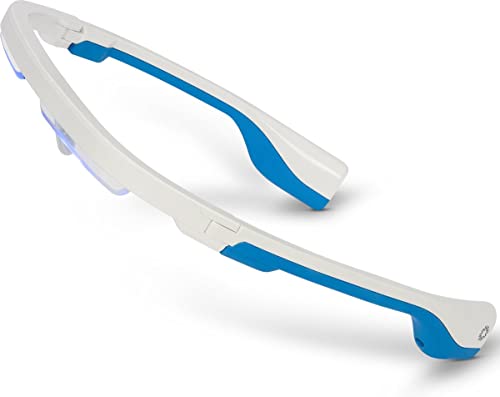
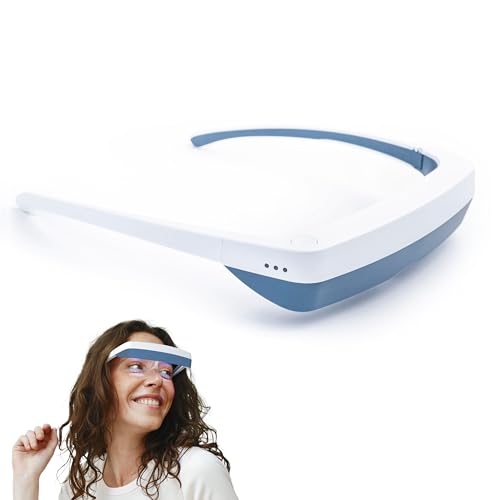
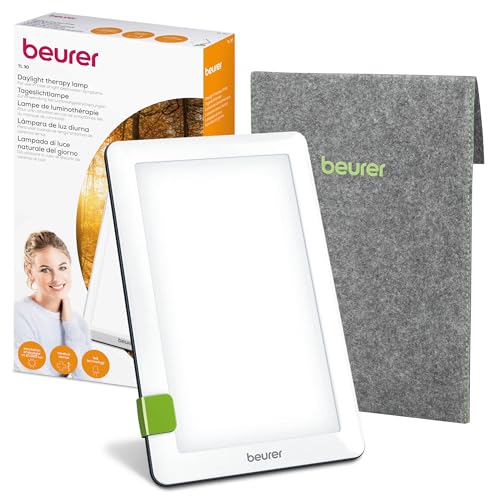
Does the model suit your lighting task?
AYO+ light therapy glasses with red light mode stand in this selection for a wearable light application without a fixed seat. It is not intended as a replacement for a SAD lamp with a documented measuring distance and not as medical treatment. That is a narrower and more honest statement than a blanket “good” or “bad”. A lamp can be technically decent and still disappoint in the wrong place. That is why this review starts with the intended use, not with a score.
The manufacturer states up to 250 microwatts per square centimetre at 470 nanometres and describes this as equivalent to 10,000 lux. Do the sum yourself: 250 microwatts per square centimetre are 2.5 W per square metre. At 470 nanometres the eye's sensitivity is about 0.09, and with the photometric radiation equivalent of 683 lumens per watt this gives around 62 lumens per watt and therefore roughly 155 lux. By its equation the manufacturer means the stimulus to the inner light sensors, not brightness. The figure is therefore unsuitable as a brightness comparison with a floor-standing lamp.
For this model there are 5 readable product features from the Amazon listing. They are not presented as independently confirmed measured values. We explicitly separate what the source states from our practical assessment. We do not claim any long-term, laboratory or room trials of our own. We reproduce the quoted listing texts unchanged in content, but apply the house style for punctuation: dashes become a colon or comma, ranges are written out with “to”, and special characters and advertising symbols are removed. Numbers, units and statements are left untouched.
Product data and sources
| Product | AYO+ light therapy glasses with red light mode |
|---|---|
| Brand | AYO |
| Category | SAD lamps |
| ASIN | B0B88BCDXQ |
| Sources as of | 27 August 2026 |
| Type of research | Data and source analysis; no laboratory or long-term trial of our own |
Listing claim: Experience 100% natural energy, Ayo uses the power…
What the source says: Experience 100% natural energy, Ayo uses the power of blue-turquoise light (470 nm) to support the body's biorhythm. By imitating the beneficial effect of the sun, Ayo naturally boosts your sleep, your mood and your energy level, without you having to take energy drinks, caffeine, pills or other unnatural substances! Say goodbye to winter depression.
Why it matters: This claim describes a product property, but does not yet answer whether it is practical for a wearable light application without a fixed seat. What matters is the link to the planned place of use. This is a health promise for a device that the manufacturer, on its own page, expressly does not list as a medical device under Regulation (EU) 2017/745. Anyone who suffers from low mood in winter should have it medically assessed, and before buying a device. The manufacturer's instructions even expressly require medical consultation before the first use for seasonal affective disorder and for bipolar disorder. Light application does not replace medical treatment.
Listing claim: Based on your personal goals and biorhythm…
What the source says: Based on your personal goals and biorhythm, applying light therapy without taking your personal rhythm, lifestyle and goals into account makes no sense. The Premium app Ayo included in the scope of delivery offers you comprehensive guidance, insights and concrete recommendations to promote your sleep quality, mood and energy efficiency optimally with our light therapy.
Why it matters: With this device the app is not an interface to home automation but its user interface. What matters is therefore which functions remain reachable without a phone and whether an account is needed for setup. Lifetime access to the app is indeed included in the scope of delivery, and the manufacturer mentions no running subscription anywhere. The sentence leaves out the other direction, though: according to the manual, setup requires app installation and creating an account, and the three intensity levels are chosen in the app's settings menu. The manufacturer's FAQ, by contrast, claims that you need neither a smartphone nor an app. Without a phone the device therefore runs, but without a phone you do not control it either.
Listing claim: Unique
What the source says: Unique: “Red light” function (670 NM) for the relaxation routine, in addition to the familiar daylight sessions you can now also use the Ayo+ as part of your evening routine. Thanks to the gentle red light (670 nm) you can let the day fade out pleasantly and create a relaxed atmosphere, for example when reading or relaxing on the sofa. This new application means that the Ayo+ is suitable not only for daytime use but is also a valuable aid for everyone who wants to consciously slow down and relax at the end of the day.
Why it matters: For the assessment, what counts is whether this feature brings a concrete advantage in everyday use. Without a matching lighting task it remains mainly a data sheet point. The red light is the difference from the predecessor model, and the manufacturer assigns it on its own topic page to a biohacker mode that is activated by a switch in the app. In the manual stored with the listing, red light-emitting diodes do not appear at all, because this edition dates from 2018 and describes four blue light-emitting diodes. The only literature reference that the manufacturer gives for 670 nanometres could not be resolved via the DOI given and deals in substance with seeing in old age, not with relaxing in the evening.
Listing claim: Unrestricted mobility, with Ayo you are not…
What the source says: Unrestricted mobility, with Ayo you are not tied to one place like with a SAD lamp. Enjoy freedom and convenience, even on hectic mornings. This stylish, lightweight light therapy glasses (only 32 g) guarantees constant light exposure. In addition, Ayo is compatible with your normal glasses.
Why it matters: This claim describes a product property, but does not yet answer whether it is practical for a wearable light application without a fixed seat. What matters is the link to the planned place of use. The manufacturer's manual says it the other way round: the glasses can be placed over most prescription frames, but for optimum effect the manufacturer expressly recommends use without prescription glasses, because glasses disturb the light distribution. The manual rules out tinted and self-tinting lenses entirely. If you wear prescription glasses permanently, this is therefore not a side issue but something to think through before buying.
Listing claim: 100% risk-free
What the source says: 100% risk-free: Ayo has been extensively examined in 13 clinical studies and honoured with several awards (including the SleepTech Award 2022 and the Red Dot Award). But more important is that we warmly invite you to experience the Ayo+ light therapy glasses personally, for your mood, your sleep and your energy level. If you are not satisfied, we will refund your money without questions or problems.
Why it matters: Before buying, this point should be matched against dimensions, manual and existing installation. A listing can contain variants or shortened wording. This number cannot be verified and does not even match the manufacturer's own statements. The science page today speaks of more than 30 clinical studies, but lists not a single one with title, journal or reference. The manufacturer's FAQ names two published papers, likewise without a reference. Study references without a source are provider claims, not a verified effect.
Use in daily life
Nothing gets set up here. There is no footprint, no cable run and no socket needed during use, because the device runs on its built-in rechargeable battery and charges over USB-C. What matters day to day is how it sits on the nose, how well you tolerate it over 20 minutes, and whether you also wear prescription glasses. Much of the control sits in an app that talks to the glasses over Bluetooth and requires an account.
For this model, the purchase decision should therefore hinge on a concrete situation. Before buying, write a sentence such as: “I need light for …” and add place, time of day and activity. If the model does not clearly fulfil this task, an alternative from the same category is probably the better choice.
This device is not built for bright light use in the classic sense, and it is no use at all as room lighting. It does not light up a surface, it does not illuminate a desk and it does not replace a lamp. Light use also does not replace medical treatment. Eye conditions, photosensitising medication and mental health conditions should be clarified with a professional beforehand, and the manufacturer itself requires this in several places in its instructions.
Strengths and limits of the assessment
What speaks for the model
- Product image, ASIN and listing data are clearly linked to one another.
- The design can be matched to a specific lighting task: for portable light use without a fixed seat, not as a replacement for a SAD lamp with a documented measuring distance and not as medical treatment.
- The available features allow a targeted check before buying, without inventing a star rating.
What remains open
- No long-term use of our own, no light measurement and no documented load check.
- Listing details can be abbreviated or change with variants and model updates.
- Room effect, glare and ease of use depend on your location and daily routine.
This purchase most often fails on the expectation that a device in this price band is a compact SAD lamp you wear. It is not: the amount of light is given in a different unit, there is no measuring distance, and the manufacturer itself lists the device as a wellness product and not as a medical device. The second pitfall is the app, because intensity levels and the red light mode sit there, while the manufacturer FAQ suggests the opposite. And the third pitfall is the advertising claims about studies: three different figures from the same supplier, none with a traceable reference, prove nothing.
What you should measure and check before buying
With light therapy glasses, distance planning falls away entirely, because the source sits in front of the eye and the manufacturer gives no measuring distance for its values. Measure your morning instead: how many uninterrupted minutes do you really have in which you can wear the glasses and do something else with your eyes open. Check whether you wear prescription glasses, because the manufacturer expressly recommends use without them and rules out tinted or self-tinting lenses. And clarify beforehand whether you have an eye condition, take photosensitising medication or have a mental health condition, because the manufacturer itself asks for medical advice in those cases.
- Clarify the task: First decide whether you want a portable light application or a free-standing SAD lamp with a documented measuring distance. These are two different device classes with different units.
- Work through your morning: Check whether you have 20 uninterrupted minutes with your eyes open and the glasses on your nose, without the routine falling apart.
- Check your vision aid: Clarify whether you wear prescription glasses permanently. The manufacturer recommends use without them and rules out tinted lenses.
- Clarify your health first: Eye conditions, photosensitising medication and mental health conditions should be put in expert hands before the first use.
- Match the model: Alongside the AYO+, AYO lists earlier versions without an app and without red light. Match the model name and article number against the current listing.
If you are unsure how much light your room needs at all, work it out once: the lumens-to-watts chart translates wattage figures into actual brightness, and how many lumens per room you need depends on floor area and activity. More models in this area are listed in the overview of SAD lamps, and the lighting calculator turns your room into a concrete target brightness.
Set-up, position and first check
Read the instructions in full before you put the glasses on for the first time, and decide on the time of day at which you want to wear them regularly. Then set up the app and account, because intensity level and red light mode are selected there. Put the glasses on so that the light bar sits above your line of sight: looking straight into the bar is expressly not the aim. If you wear prescription glasses, try the combination out calmly before relying on a fixed morning routine.
The usual evening check of a lamp does not apply here: there is no placement location, no reflections in the room and no switch position that could be wrong. Instead, check after the first few uses whether the frame presses over 20 minutes, whether the light bar stays at the upper edge of your field of view and whether you feel unwell while using it. If so, stop and get medical advice, rather than shortening the duration on your own.
Keep the manual and model designation. This helps with spare parts, with a later query about the product and in a guarantee claim. Replacing the light source is not intended; at the end of its lifetime the whole device is replaced.
Comparison with similar models
The comparison does not name winners. It shows models of the same category so that you can see whether one of them is closer to your lighting task. If two models have the same task in the Assessment column, they do not differ in purpose but in design, dimensions and features. The column then states what is actually different according to the sources.
| Model | Brand | Assessment | Details |
|---|---|---|---|
| AYO+ light therapy glasses with red light mode | AYO | for portable light use without a fixed seat, not a substitute for a SAD lamp with a documented measuring distance and not as medical treatment | This review |
| AYOlite light glasses | AYO | for portable light use without an app and without a fixed seat, not a substitute for a SAD lamp with a documented measuring distance | Read review |
| Luminette 3 light therapy glasses | Luminette | for portable light use with fixed intensity levels | Read the review |
Our buying decision
AYO+ light therapy glasses with red light mode make sense if you are looking for a device for portable light use without a fixed seat, have checked the dimensions at the intended spot and will actually use the functions named in the listing. The purchase is less convincing if you expect a universal solution for several conflicting lighting tasks.
Keep looking if key data such as dimensions, light output, IP rating or compatibility is not clearly documented for your intended use. The same applies if you only like the look of the design, but the cable, the floor space or the controls would get in your way in daily use.
We deliberately award no stars. A numerical score would suggest a measurement accuracy that does not exist without documented hands-on testing. The statement this page can support is narrower: which details are available, what the model may be suited for, and which questions remain open before you buy?
Frequently asked questions about the AYO+ light therapy glasses
How much light does the AYO+ really deliver?
The manufacturer states an irradiance of up to 250 microwatts per square centimetre at 470 nanometres and itself describes this as equivalent to the 10,000 lux of a light box. If you convert this radiant power into an illuminance using the eye's sensitivity at 470 nanometres, you end up at roughly 150 lux, not 10,000. That is our own rough calculation. By its equation the manufacturer means the stimulus to the eye's inner light sensors and not brightness, and that is exactly why a numerical comparison with a floor-standing lamp does not hold.
Is the AYO+ a medical device?
No, and the manufacturer says so very clearly itself. Its instructions and conformity page states that the product is marketed as a general wellness device and is not regulated as a medical device under Regulation (EU) 2017/745. What is documented, by contrast, is light safety: TÜV Rheinland confirms classification under IEC 62471 in the exempt group. Light application does not replace medical treatment.
Do I need an app or an account for the glasses?
The manufacturer's FAQ says no smartphone and no app are needed for use. The same manufacturer's instructions, however, describe the initial setup via app installation and creating an account, and the three intensity levels low, medium and high are chosen in the app's settings menu. The red light is also a mode that the manufacturer describes as activated by a switch in the app. Without a phone you therefore get light, but no control.
How long does a session last?
In its FAQ the manufacturer gives 20 minutes as a typical session and in the instructions an upper limit of one hour per day. The three intensity levels are linked to the duration: a higher intensity shortens the time, and according to the instructions the device adjusts the duration automatically. The device's instructions are always what counts, not a comparison with a floor-standing lamp.
Who is the application not suitable for?
The manufacturer's instructions give a long list: keep away from children under four years, not suitable under 18 years, not recommended with cataract, glaucoma, macular degeneration, other retinal diseases or after eye surgery, likewise with light sensitivity, epilepsy and seizures. The manufacturer requires medical consultation before use for bipolar disorder, for seasonal affective disorder, for eye diseases in the family and for light-sensitising medication. According to the instructions, these include antibiotics, antihistamines, chemotherapy drugs and heart, diabetes and skin medication, among others.
What distinguishes the AYO+ from the AYOlite?
That can no longer be answered cleanly from manufacturer sources today, and that is the honest answer. AYO's shop now lists only one device, the AYO+, and a search for the name AYOlite returns exactly this product. From the remaining information this much is left: the AYOlite was sold as a version without a Bluetooth connection and without an app and was clearly lower in price, and the AYO+ adds the red light function. There is no manufacturer statement on different amounts of light or session durations for the two models.
Sources and currency
The sources are ranked by their closeness to the product: manufacturer documents come before retailer or comparison data. A shop listing is useful for the variant currently on offer, but it is not an independent check. Missing documents are not replaced with invented experiences.
- Listing page for ASIN B0B88BCDXQ. Everything that appears only here is a supplier claim: blue-turquoise light at 470 nanometres, a red light function at 670 nanometres, a weight of 32 grams, a premium app included in the box, 13 clinical studies, the SleepTech Award 2022 and the Red Dot Award. Illuminance, irradiance, a duration of use and the number of intensity levels appear nowhere in the listing. The attribute table of the same listing gives a head-worn pair of glasses a BA15D light bulb base, a BA10 bulb shape, a table top mounting type and the statement that the product is not cordless, while the power supply is listed as battery-powered. Amazon listing B0B88BCDXQ, not linked
- Manufacturer FAQ from AYO. It contains the only reliable light figures: blue-turquoise light of roughly 470 nanometres, irradiance of up to 250 microwatts per square centimetre, which the manufacturer itself describes as equivalent to the 10,000 lux of a typical light box. A typical session lasts 20 minutes. Light safety was assessed by TÜV Rheinland to IEC 62471 and classified in the exempt group, with ANSI Z80.36 and ISO 15004-2 in addition. It states expressly that no smartphone and no app are needed for use and that AYO is not a medical device. Guarantee: two years in Europe, one year in the rest of the world.
- Manufacturer product page. The shop currently lists exactly one device, the AYO+, in white and in Carbon Black, with article number AYO24 for the white version. The contents include glasses, case, USB-C cable, a one-year international guarantee and lifetime access to the AYO app. This page gives no technical data: no wavelength, no irradiance, no duration of use, no weight. At the foot of the page it states that AYO is a non-medical wellness device for healthy adults.
- Manufacturer topic page on the two wavelengths. It names blue at 470 nanometres and red at 670 nanometres and assigns the red light expressly to a biohacker mode, which is activated by a switch in the app. The only literature reference given for the red light is a paper by Shinhmar and others, cited as Scientific Reports 2020, volume 10, article 15272, with a DOI. This DOI could not be resolved through doi.org on 27 August 2026. The entry in the source line also carries a foreign-language title and an inserted brand name of another supplier.
- Manufacturer instructions and conformity page. It contains the clearest statement on classification: the product is marketed as a general wellness device and is not regulated as a medical device under Regulation (EU) 2017/745. It adds that the statements have not been assessed by any approval authority. No instructions are available to download on this page.
- Manufacturer science page. In a key figures line it names more than 30 clinical studies and cooperation with research institutions, but it lists not a single study with title, journal or reference. Elsewhere, the manufacturer FAQ mentions two published papers, one with the United States Department of Defense and one with Reykjavik University, likewise without a reference.
- Manufacturer instructions in PDF format, as attached to the listing, third edition of June 2018, published by Novalogy Inc., 340 S Lemon Ave 8535, Walnut, California. Technical data: glasses 155 by 65 by 23 millimetres and 35 grams, case 173 by 80 by 65 millimetres and 180 grams, four blue LEDs with a centre wavelength of 470 nanometres plus or minus 2 nanometres, full width at half maximum 22 nanometres, typical irradiance 150 and maximum 250 microwatts per square centimetre, pulse frequency 1,000 Hz, service life over 10,000 hours, battery 3.7 V with 100 mAh, ambient temperature 0 to 40 degrees. This edition does not describe red LEDs. Setup requires installing the app and creating an account. Warnings: keep away from children under four years, not suitable under 18 years, not recommended for eye conditions such as cataract, glaucoma, macular degeneration, other retinal diseases or after eye surgery, nor for light sensitivity, epilepsy or seizures; medical advice before use for bipolar disorder, seasonal affective disorder, a family history of eye conditions and photosensitising medication such as antibiotics, antihistamines, chemotherapy drugs and heart, diabetes and skin medication. It states expressly that AYO is not a medical device and that the glasses should not be worn together with tinted or self-tinting prescription glasses.
- Complete manufacturer instructions in PDF format, mirrored by a specialist retailer. It contains the section on light intensity: there are three intensity levels called low, medium and high, and they are selected in the settings menu of the AYO app. A higher intensity shortens the duration of use, and the device adjusts the duration automatically. On prescription glasses it states that use without them is recommended for optimal effect, because glasses can disturb the light distribution.
- Search for the term AYOlite in the manufacturer shop. It returns no product of its own, but the AYO+ as the only result. The international shop goayo.com no longer lists the AYOlite, neither as a product nor with a data sheet. The German-language brand site goayo.de, according to the AYOlite page, still lists the AYOlite as a version without an app. A manufacturer statement on how the AYO+ and AYOlite differ technically cannot therefore be found on goayo.com.
- Amazon product listing B0B88BCDXQ; product data via the Creators API, retrieved 27 August 2026 Advertisement
Content checked on 27 August 2026. Prices, availability and product variants can change independently of this page. For the final check, always use the current retailer listing and any available manufacturer documents.
If a linked source is no longer reachable, or the model on offer visibly differs from the product image and designation, this analysis is no longer the right basis for a decision. In that case the current model number is what counts. Tell us about the difference via the contact page (in German), so that the data, the link and the recommendation can be checked.