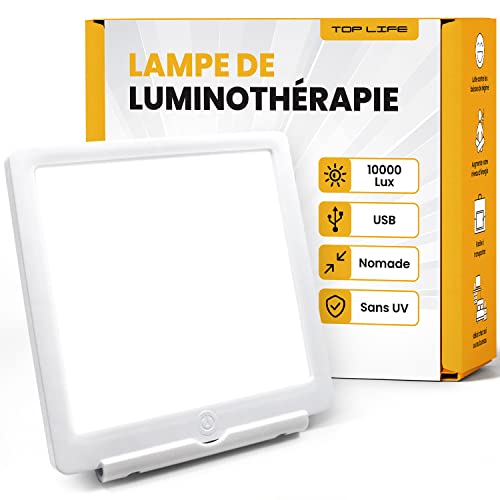
Does the model suit your lighting task?
Easysleep LTL-A2 SAD lamp, 18 W, 10,000 lux at around 20 cm stands in this selection for a short daily light session at the desk at a fixed close distance, either standing on the base or hanging on the wall. That is a narrower and more honest statement than a blanket “good” or “bad”. A lamp can be technically decent and still disappoint in the wrong place. This review therefore begins with the intended use, not with a score.
Ten thousand lux always apply only at a specific distance, and this device is the only one of the three checked today that states it: around 20 centimetres. This makes it possible for the first time to calculate what reaches the seat. The supplier itself allows a usage distance of up to around 51 centimetres, and there, by calculation, only about 1600 lux remain. The advertised figure therefore describes a close-range application, not desk lighting.
For this model there are 5 readable product features from the Amazon listing. They are not presented as independently confirmed measured values. We explicitly separate what the source states from our practical assessment. We do not claim any long-term, laboratory or room trials of our own. We reproduce the quoted listing texts unchanged in content, but apply the house style for punctuation: dashes become a colon or comma, ranges are written out with “to”, and special characters and advertising symbols are removed. Numbers, units and statements are left untouched.
Product data and sources
| Product | Easysleep LTL-A2 SAD lamp, 18 W, 10,000 lux at about 20 cm |
|---|---|
| Brand | Easysleep |
| Category | SAD lamps |
| ASIN | B08N149XTD |
| Sources as of | 31 July 2026 |
| Type of research | Data and source analysis; no laboratory or long-term trial of our own |
Listing detail: One-key up to 10000 lux
What the source says: One-key up to 10000 lux: Offers one-touch 10000 lux, suitable for people who lack sunlight, this light will be a great companion in sunshine.
Why this matters: A lux figure necessarily comes with a measuring distance. If this increases, much less illuminance arrives at the eye or on the work surface. According to the supplier's technical data, the 10000 lux apply only at a distance of 8 inches, so around 20 centimetres. The supplier's instructions for use allow 8 to 20 inches, and at the upper end the illuminance falls, by calculation, to about 1600 lux. The figure is therefore tied to a very close distance. The supplier does not document any effect, and there is no classification as a medical device. At the same time, the same supplier gives warnings about eye conditions and lithium treatment. The benefit claim is purely a supplier statement.
Listing detail: 6 timer settings
What the source says: 6 timer settings: You can set it for continuous work or set a timer of 10, 20, 30, 40, 50, 60 minutes auto-off.
Why this matters: This point should be checked against dimensions, instructions and the existing installation before buying. A listing can contain variants or shortened wording. The six levels from 10 to 60 minutes are confirmed in the description text. In the instructions for use, however, the supplier recommends 20 to 30 minutes, so the long levels go beyond its own recommendation.
Listing detail: Memory function
What the source says: Memory function: With the memory function it can help you quickly restore your previous brightness and timer.
Why this matters: For the assessment, what counts is whether this feature brings a concrete advantage in daily use. Without a suitable lighting task, it remains mainly a data sheet point.
Listing detail: 2 flexible placement designs
What the source says: 2 flexible placement designs: You can place it on the desk or hang it on the wall. At 24.6 x 17.5 x 1.8 cm it is portable.
Why this matters: This detail describes a product feature, but does not yet answer whether it is practical for a short daily light session at the desk at a fixed close distance, either standing on the base or hanging on the wall. What matters is the link to the planned location. The detail table of the same listing gives 24.8 by 17.6 by 2 centimetres, the description text around 25 by 18 centimetres. More important is the effective illuminated area of about 12 by 14 centimetres, which is clearly smaller than the housing.
Listing detail: 12 months guarantee & 100% satisfaction guarantee
What the source says: 12 months guarantee & 100% satisfaction guarantee: Do not hesitate to contact us with any problem.
Why this matters: This is a commitment by the seller from the listing text, not a manufacturer document and not an additional legal right. Your statutory rights apply regardless. A voluntary guarantee only counts once its conditions are available in writing. The promised 12 months are below the statutory warranty of two years, which applies independently when buying in Germany. The statement does not reduce your rights, but describes only the supplier's voluntary commitment.
Use in daily life
A large light surface can be more comfortable when it gives more freedom of movement, but it needs more space. A small device is easier to carry and usually requires more precise positioning. This trade-off matters more in daily life than a size comparison on product photos.
For this model, the purchase decision should therefore hinge on a concrete situation. Before buying, write a sentence such as: “I need light for …” and add place, time of day and activity. If the model does not clearly fulfil this task, an alternative from the same category is probably the better choice.
SAD lamps are not ordinary desk lamps and are no substitute for medical advice. With eye conditions, light sensitivity, certain medications or mental health conditions, use should first be discussed with a qualified professional.
Strengths and limits of the assessment
What speaks for the model
- Product image, ASIN and listing data are clearly linked to one another.
- The design can be matched to a specific lighting task: for a short daily light session at the desk at a fixed close distance, either standing on the base or hanging on the wall.
- The available features allow a targeted check before buying, without inventing a star rating.
What remains open
- No long-term use of our own, no light measurement and no documented load check.
- Listing details can be abbreviated or change with variants and model updates.
- Room effect, glare and ease of use depend on your location and daily routine.
The wording against depression is in the title and reads like a documented application, but in fact it is purely a supplier statement without approval, without a study and without a CE marking with a notified body. Equally misleading is the figure of 10,000 lux if you take it for the normal seating distance: it applies at around 20 centimetres, while the supplier itself allows up to 51 centimetres, where by calculation only about 1,600 lux arrive. If you place the lamp further away like an ordinary desk lamp, you therefore get a fraction of the advertised value.
What remains of 10,000 lux at 50 centimetres
Illuminance falls with the square of the distance. If the distance doubles, a quarter remains. The 10,000 lux of this device apply at around 20 centimetres. At 40 centimetres, by calculation about 2500 lux remain, at 50 centimetres around 1600 lux, at one metre about 400 lux. This is not criticism of the device but physics, and it applies to every lamp of this type.
In practice this means: a panel of around 25 by 18 centimetres must permanently stand on the table at arm's length if the advertised order of magnitude is to be reachable at all. If you place the lamp further back like an ordinary desk lamp, you get a fraction of it. Check before buying whether this space stays free in daily life.
The stated measuring distance is at the same time the strongest argument of this page. Two other devices checked today advertise 12,000 and 13,000 lux and state no distance for it. A higher figure without a reference point is not a better device. Conversely, the distance here is in the listing text and not in a manufacturer document, because none exists for this model.
What you should measure and check before buying
Measure the distance between the planned position of the lamp and your face, because the advertised 10,000 lux apply only at about 20 centimetres and fall, by calculation, to about a sixth at around 50 centimetres. Also check whether there is permanent room on your desk for a panel of around 25 by 18 centimetres at this proximity, and clarify with a doctor beforehand if you have eye conditions or take photosensitising medication, because the supplier itself points this out.
- Define the task: Write down which surface or zone is to be lit and at what time of day you use it.
- Measure the space: Check the standing or mounting surface, height, cable route and reachable socket. Product photos are no substitute for measurements.
- Compare the light data: Check light output, colour temperature, dimming and, if needed, IP rating in the current listing text. There is no manufacturer document to consult for this item.
- Think through the controls: The switch, app, sensor or remote control must be reachable and understandable in daily use at the planned location.
- Check the variant: Colour, size and set contents can differ within one listing, and often the technical details in the description text with them. Compare the selected variant with this analysis.
If you are unsure how much light your room needs at all, work it out once: the lumens-to-watts chart translates wattage figures into actual brightness, and how many lumens per room you need depends on floor area and activity. More models in this area are listed in the overview of SAD lamps, and the lighting calculator turns your room into a concrete target brightness.
Set-up, position and first check
There is no manufacturer document for this device, but there is a section on use in the listing itself: 20 to 30 minutes at a distance of 8 to 20 inches. Stick to these details, place the lamp offset to the side and do not look directly into the illuminated area. The supplier expressly names contraindications for eye conditions, for treatment with lithium and for photosensitising medication. Clarify health questions with a doctor beforehand, light use does not replace treatment.
After set-up, do not judge the light only in daylight. In the evening, switch the rest of the lighting as you normally use it, and check the situation from seated, standing and walking height. Only then do disturbing reflections, hard shadows or an unfavourable switch position become visible.
Note the model number and order date and keep whatever paperwork is in the box. For this item there is neither a manual nor a manufacturer page to download, and in a complaint the retailer is the only point of contact. Both are, in a guarantee claim, the only proof of which device you bought. Replacing the light source is not provided for, and at the end of its rated lifetime the complete device is replaced.
Comparison with similar models
The comparison does not name winners. It shows models of the same category so that you can see whether one of them is closer to your lighting task. If two models have the same task in the Assessment column, they do not differ in purpose but in design, dimensions and features. The column then states what is actually different according to the sources.
| Model | Brand | Assessment | Details |
|---|---|---|---|
| Easysleep LTL-A2 SAD lamp, 18 W, 10,000 lux at about 20 cm | Easysleep | for a short daily light session at the desk at a fixed close distance, either standing on the base or hung on the wall | This review |
| Wholede KJ-3133A SAD lamp | Wholede | for additional brightening of a desk or bedside spot in the dark season, operated by remote control and timer | Read the review |
| NEEMOSI SKTL-5002 SAD lamp | NEEMOSI | for brightening a larger work or living area with adjustable colour temperature, set up as a table lamp with all-round emission | Read the review |
Our buying decision
Easysleep LTL-A2 SAD lamp, 18 W, 10,000 lux at around 20 cm makes sense if you are looking for a light for a short daily light session at the desk at a fixed close distance, either standing on the base or hanging on the wall, have checked the dimensions at the intended spot and will actually use the functions named in the listing. The purchase is less convincing if you expect a universal solution for several conflicting lighting tasks.
Keep looking if key data such as dimensions, light output, IP rating or compatibility is not clearly documented for your intended use. The same applies if you only like the look of the design, but the cable, the floor space or the controls would get in your way in daily use.
We deliberately award no stars. A numerical score would suggest a measurement accuracy that does not exist without documented hands-on testing. The statement this page can support is narrower: which details are available, what the model may be suited for, and which questions remain open before you buy?
Frequently asked questions about the SAD lamp
At what distance do the 10,000 lux apply?
8 inches, so around 20 centimetres, as stated in the supplier's technical data, and the price comparison site Geizhals lists the same value as 20 cm. That is very close to the face. The instructions for use at the same time allow 8 to 20 inches, and at 20 inches the illuminance falls, by calculation, to about 1,600 lux.
Can I adjust the colour temperature?
No. The UK listing of the same device gives a fixed colour temperature of 6,500 kelvin, and the German bullet points speak exclusively of ten brightness levels. The detail table does claim an adjustable colour temperature, but the supplier's own specification contradicts this.
Is the lamp a medical device, even though the title mentions depression?
No. The word medical device does not appear anywhere on the listing page, and a CE marking with a notified body or a declaration of conformity could not be found. At the same time, the supplier includes warnings about eye conditions, lithium treatment and photosensitising medication, that is, notes you would otherwise know from approved devices.
How much power does the device use?
18 watts. According to the specification the power supply delivers 20 volts at 0.9 amperes, and 20 times 0.9 gives exactly these 18 watts, so the figures agree arithmetically. Geizhals independently also lists 18 watts mains operation.
How large is the area that actually lights up?
Roughly 12 by 14 centimetres, because the UK listing of the same device gives an effective illuminated area of 4.7 by 5.5 inches. The housing, by contrast, measures around 25 by 18 centimetres, so the illuminated area is clearly smaller than the outer dimensions suggest.
Sources and currency
The sources are ranked by their closeness to the product: manufacturer documents come before retailer or comparison data. A shop listing is useful for the variant currently on offer, but it is not an independent check. Missing documents are not replaced with invented experiences.
- Geizhals data sheet: 10000 lx explicitly at 20 cm distance, 18 W mains operation, energy class E, wall mounting optional
- UK listing of the same device with full specification: power supply AC 100 to 240 V, DC 20 V and 0.9 A, 18 W, 10000 lux at 8 inches, 6500 kelvin, effective illuminated area 4.7 by 5.5 inches, weight 0.25 kg Amazon listing B08LDBVXGD, not linked
- Second German listing of the same device with identical technical data, 18 watts stated, different UPC Amazon listing B08LDTV7VH, not linked
- Listing with model number LTL-A2, section with measuring distance of 8 inches, usage distance 8 to 20 inches, usage duration 20 to 30 minutes and warnings about eye conditions and lithium treatment Amazon listing B08N149XTD, not linked
- Amazon product listing B08N149XTD; product data via the Creators API, retrieved 31 July 2026 Advertisement
Content checked on 31 July 2026. Prices, availability and product variants can change independently of this page. For the final check, always use the current retailer listing and any available manufacturer documents.
If a linked source is no longer reachable, or the model on offer visibly differs from the product image and designation, this analysis is no longer the right basis for a decision. In that case the current model number is what counts. Tell us about the difference via the contact page (in German), so that the data, the link and the recommendation can be checked.