Does the model suit your lighting task?
LIORQUE SM-02 wake-up light, sunrise up to 60 minutes, 185 lumens according to the data sheet, stands in this selection for a slow light start in the morning and calm sounds in the evening. It is not intended for bright light use during the day. That is a narrower and more honest statement than a blanket “good” or “bad”. A lamp can be technically decent and still disappoint in the wrong place. That is why this review begins with the intended use, not with a score.
There is no lux figure for this model, but there is one reliable number: the stored product data sheet reports 185 lumens of useful luminous flux in the 360 degree sphere at 3.5 watts in class G. A sphere covers about 12.57 steradians, 185 divided by 12.57 gives about 14.7 candela average luminous intensity, and divided by the square of the distance that is about 164 lux at 0.3 metres. Even if all the light went forwards, it would be about 330 lux there. Compared with the 10,000 lux of a SAD lamp, that is a factor of 30 to 60.
For this model there are 5 readable product features from the Amazon listing. They are not presented as independently confirmed measured values. We explicitly separate what the source states from our practical assessment. We do not claim any long-term, laboratory or room trials of our own. We reproduce the quoted listing texts unchanged in content, but apply the house style for punctuation: dashes become a colon or comma, ranges are written out with “to”, and special characters and advertising symbols are removed. Numbers, units and statements are left untouched.
Product data and sources
| Product | LIORQUE SM-02 wake-up light, sunrise up to 60 minutes, 185 lumens according to the data sheet |
|---|---|
| Brand | LIORQUE |
| Category | SAD lamps |
| ASIN | B0FB9CWT4D |
| Sources as of | 27 August 2026 |
| Type of research | Data and source analysis; no laboratory or long-term trial of our own |
Listing statement: Wake up naturally
What the source says: Wake up naturally: Experience a gentle and gradual sunrise simulation that imitates the dawn, from darkness to a soft, warm light, accompanied by soothing nature sounds. The entire waking process can take up to 60 minutes and offers a refreshing alternative to harsh alarm tones
Why this matters: With a sensor, detection angle, range, mounting height and possible false triggering count. These points cannot be fully derived from a bare mention of a function. This is the core function and the documented part of the listing. The wording up to matters: the seller gives no steps in which this duration can be set, and no instructions are available anywhere for this model. Plan the sound as a second way of waking from the start, because an amount of light in the order of 150 to 330 lux is a gentle stimulus and not a reliable alarm clock.
Listing statement: 30 soothing sounds
What the source says: 30 soothing sounds: More than just an ordinary alarm clock, fall asleep gently with our integrated sound generator. With 20 natural and relaxing melodies and 10 white noise options. In 30 adjustable volume levels you can create the perfect sleep environment
Why this matters: This point should be checked against the dimensions, instructions and existing installation before you buy. A listing can contain variants or shortened wording.
Listing statement: Versatile night light
What the source says: Versatile night light: Enjoy 12 brightness levels with warm white and cool white light options, including a gentle breathing light. Set the night light and white noise to a sleep timer of 30 to 180 minutes to fall asleep peacefully
Why this matters: The stated colour temperature describes the effect, not the brightness. In everyday use it matters whether fixed steps or a continuous range are offered and whether the setting is saved. The number contradicts the detailed manufacturer section on the same listing page, which speaks of 13-step adjustable lighting. The statement fits the product data sheet as regards colour temperature, which reports a range of 3000 to 6500 kelvin. However, the second model number named in the listing, SM-02, is entered in the EU product register with a single colour temperature of 5000 kelvin. Clarify the version in the current listing before ordering.
Listing statement: Stylish & cosy design
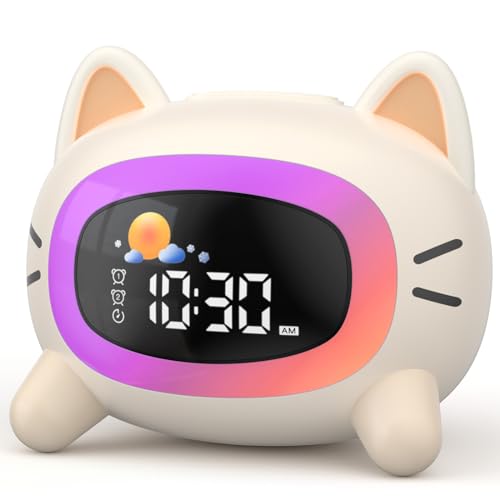
What the source says: Stylish & cosy design: The fabric-wrapped exterior gives the alarm clock warmth and texture and makes the light feel more inviting. This alarm clock fits seamlessly into your home decor and is both a beautiful and functional accent
Why this matters: This statement describes a product feature but does not yet answer whether it is practical for a slow light start in the morning and calm sounds in the evening. What matters is the connection to the planned place of use.
Listing statement: Customisable display & practical charging
What the source says: Customisable display & practical charging: The display offers 5 brightness levels, including a complete switch-off option for light-sensitive sleepers. The built-in rechargeable battery saves your settings, and a 5 W charging port lets you conveniently charge your phone overnight. This alarm clock has it all
Why this matters: A rechargeable battery that only saves the settings through a power cut is not a buying criterion: run time and charging route decide nothing here, because the device hangs permanently on its power adaptor. What matters instead is what is kept after a power cut and what has to be set again. That is exactly how it is meant and not otherwise: the battery is a settings memory in case of a power cut, not a replacement for the socket. The attribute table lists the device as corded, the product data sheet as not directly connected to mains voltage with a direct current connection, that is with a plug-in power adaptor. So plan for a reachable socket at the bedside. The 5 watt charging port also only provides slow charging for a phone. This is the practically most important point of the whole listing and it is honestly worded. If you find every light source disturbing at night, this is where you decide. After setting it up, check once in the dark whether the display can really be switched off completely and whether operation still works half asleep. No instructions are available for this model in which you could read this up beforehand.
Use in daily life
On the bedside table, space decides, and the sources disagree here. Plan for roughly 15 centimetres edge length according to the product data sheet and not for the 23 centimetres of the attribute table, which are probably the shipping dimension. The device runs from a plug-in power adaptor, and the built-in rechargeable battery only saves the settings in a power cut. A 5 watt charging port for a phone is present, and the exterior is fabric-covered, which makes the light surface look softer.
For this model, the purchase decision should therefore hinge on a concrete situation. Before buying, write a sentence such as: “I need light for …” and add place, time of day and activity. If the model does not clearly fulfil this task, an alternative from the same category is probably the better choice.
This device is not built for bright light use during the day, and it is not suitable as a reading light either. It is an alarm clock with a night light and sounds, that is a comfort device. Light use does not replace medical treatment. With persistent sleep problems, a low mood, eye conditions, light-sensitising medication or mental health conditions, get this checked by a professional beforehand.
Strengths and limits of the assessment
What speaks for the model
- Product image, ASIN and listing data are clearly linked to one another.
- The design can be matched to a specific lighting task: for a slow light start in the morning and calm sounds in the evening, not for bright light use during the day.
- The available features allow a targeted check before buying, without inventing a star rating.
What remains open
- No long-term use of our own, no light measurement and no documented load check.
- Listing details can be abbreviated or change with variants and model updates.
- Room effect, glare and ease of use depend on your location and daily routine.
This purchase fails on the expectation that the word daylight in the name raises. According to the mandatory energy-law information, the device delivers an illuminance in the order of 150 to 330 lux and not the 10,000 lux of a SAD lamp. The second trap is the model question: the attribute table and the product data sheet on the same listing page name two different model identifiers with different register values, and no instructions are available anywhere. And anyone who relies on the light alone as a wake-up stimulus will oversleep, because with this amount of light the sound is the real alarm clock.
What you should measure and check before buying
Planning the distance by lux does not apply here, because the seller gives no lux figure and the register values give an order of magnitude of 150 to 330 lux at the pillow. Instead, measure the free space on the bedside table and plan for roughly 15 centimetres edge length according to the product data sheet, not for the 23 centimetres from the attribute table, which are probably the shipping dimension. Check the height of the bedside table in relation to the pillow, so that the light falls into your field of view when lying down without shining directly at you. And measure the route to the socket, because the built-in rechargeable battery only saves the settings and does not replace the power adaptor.
- Clarify the task: First clarify whether you are looking for a gentle waking light or a bright light use during the day. These are two different device classes with a brightness difference of a factor of 30 to 60.
- Measure the space: Plan for roughly 15 centimetres edge length, check the bedside table surface and the route to the socket.
- Decide how you wake: Plan one of the 20 nature sounds or one of the 10 noise options as a second way of waking, and do not rely on the light alone.
- Think through the night: Clarify whether a lit display disturbs you at night, and use the complete switch-off of the display.
- Compare the model identifier: The listing names SM-02 and YF-01 at the same time with different register values. Compare the identifier on the rating plate after delivery.
If you are unsure how much light your room needs at all, work it out once: the lumens-to-watts chart translates wattage figures into actual brightness, and how many lumens per room you need depends on floor area and activity. More models in this area are listed in the overview of SAD lamps, and the lighting calculator turns your room into a concrete target brightness.
Set-up, position and first check
Set the wake-up time and the length of the sunrise and choose one of the 30 sounds from the start, because you should not rely on the light alone with this amount of light. Position the device so that the light surface stays visible when lying down without shining directly at you. Try out the sleep timer for night light and sound between 30 and 180 minutes once while awake before you rely on it in the evening. And check the operation once in complete darkness, because every movement counts when you are half asleep.
After set-up, do not judge the light only in daylight. In the evening, switch the rest of the lighting as you normally use it, and check the situation from seated, standing and walking height. Only then do disturbing reflections, hard shadows or an unfavourable switch position become visible.
Keep the instructions and the model designation. That helps with spare parts, with a later query about the product and in a guarantee claim. Replacing the light source is not intended; at the end of its life the complete device is replaced. This device is intended for indoor use only and is not approved for damp rooms or outdoors.
Comparison with similar models
The comparison does not name winners. It shows models of the same category so that you can see whether one of them is closer to your lighting task. If two models have the same task in the Assessment column, they do not differ in purpose but in design, dimensions and features. The column then states what is actually different according to the sources.
| Model | Brand | Assessment | Details |
|---|---|---|---|
| LIORQUE SM-02 wake-up light, sunrise up to 60 minutes, 185 lumens… | LIORQUE | for a slow light start in the morning and calm sounds in the evening, not for bright light use during the day | This review |
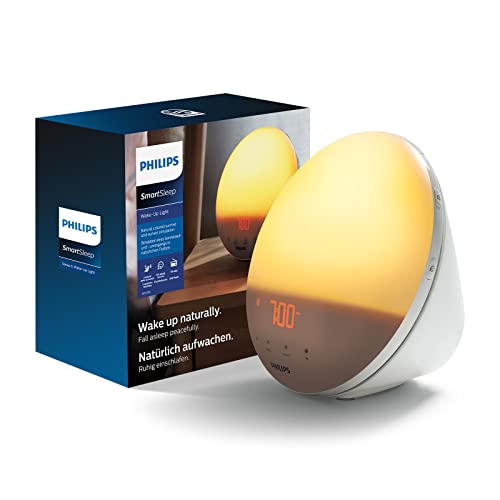
| Philips Wake-up Light HF3519/01 wake-up light | PHILIPS | for waking up with slowly brightening light, not for bright light use during the day | Read review |
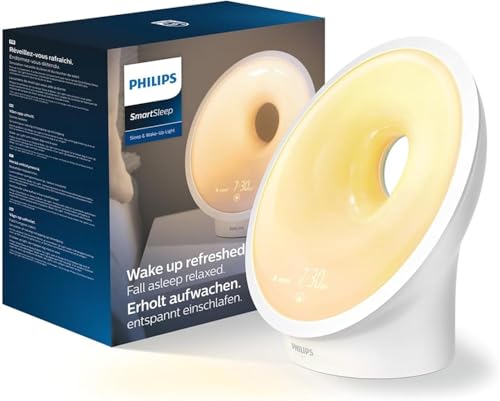
| Philips Wake-up Light HF3651/01 wake-up light | PHILIPS | for a slow light start in the morning, not for bright light use during the day | Read review |
Our buying decision
LIORQUE SM-02 wake-up light, sunrise up to 60 minutes, 185 lumens according to the data sheet makes sense if you are looking for a device for a slow light start in the morning and calm sounds in the evening, have checked the dimensions at the intended place and will actually use the functions named in the listing. The purchase is less convincing if you expect a universal solution for several conflicting lighting tasks.
Keep looking if key data such as dimensions, light output, IP rating or compatibility is not clearly documented for your intended use. The same applies if you only like the look of the design, but the cable, the floor space or the controls would get in your way in daily use.
We deliberately award no stars. A numerical score would suggest a measurement accuracy that does not exist without documented hands-on testing. The statement this page can support is narrower: which details are available, what the model may be suited for, and which questions remain open before you buy?
Frequently asked questions about the LIORQUE wake-up light
How bright does this wake-up light get?
The seller gives no lux figure, but the product data sheet attached to the listing reports 185 lumens of useful luminous flux in the 360 degree sphere at 3.5 watts. That gives an average luminous intensity of about 14.7 candela and therefore roughly 164 lux at a distance of 0.3 metres. If you calculate generously and assume that all the light goes forwards, it is about 330 lux at 0.3 metres. The honest order of magnitude at the pillow is therefore between roughly 150 and 330 lux.
Is a wake-up light the same as a SAD lamp?
No, and the difference is large. A SAD lamp works at 10,000 lux at a documented distance and comes with its own instructions for use. According to the register entries, this device has an illuminance in the order of 150 to 330 lux and is built for waking up, not for use during the day. If you want to brighten dark winter mornings, you need a different class of device.
Which model number does the device really have?
The listing contradicts itself here. The attribute table gives SM-02 as model number and item number, whereas the stored product data sheet and the energy label give the model identifier YF-01. Both identifiers are entered in the EU product register and both in class G, but with different values: YF-01 with 185 lumens at 3.5 watts, SM-02 with 133 lumens at 3.19 watts. Compare the model number with the rating plate after delivery.
How big is the alarm clock really?
This is also inconsistent. The listing's attribute table gives 13.3 by 23 by 13.3 centimetres at 400 grams, whereas the product data sheet gives 150 by 150 by 150 millimetres and the second register entry 94 by 94 by 160 millimetres. The 23 centimetres are very probably the shipping dimension. So plan for roughly 15 centimetres edge length, and you will be on the safe side.
How does this device differ from the LIORQUE sleep trainer for children?
They are two different device classes from the same brand. The sleep trainer under ASIN B0CHJNX3L3 is rabbit-shaped and uses a sun symbol and a moon symbol to show when it is time to get up and when it is time to sleep, plus 6 ringtones, 7 sleep melodies and, according to the listing, 4 fixed light colours (the manufacturer's instructions mention 5 colours). It has no sunrise simulation. This model simulates a sunrise over up to 60 minutes, is aimed at adults and has neither a sun nor a moon display.
Is the device a medical device?
No, no classification can be found for it, and the seller makes no medical claim. An alarm clock with a light is a comfort device. Light use does not replace medical treatment, and if you have persistent sleep problems or a low mood, get this checked by a professional beforehand. Eye conditions, light-sensitising medication and mental health conditions should also be clarified professionally beforehand.
Sources and currency
The sources are ranked by their closeness to the product: manufacturer documents come before retailer or comparison data. A shop listing is useful for the variant currently on offer, but it is not an independent check. Missing documents are not replaced with invented experiences.
- Listing page for ASIN B0FB9CWT4D. Seller statements: sunrise simulation from dark to warm light over up to 60 minutes, 20 natural melodies and 10 white noise options in 30 volume levels, night light with 12 brightness levels in warm white and cool white including a breathing light, sleep timer of 30 to 180 minutes, display with 5 brightness levels including complete switch-off, built-in rechargeable battery as a settings memory and a 5 watt charging port. The attribute table gives model number SM-02, item number SM-02, dimensions 13.3 by 23 by 13.3 centimetres, 400 grams, corded operation, indoor use, material metal and frame material fabric-covered. The supplementary manufacturer section of the same page, by contrast, speaks of 13-step adjustable lighting. A lux figure does not appear anywhere on the page. The title carries the addition energy class G. Amazon listing B0FB9CWT4D, not linked
- EU energy label, as stored on the listing. It names Shenzhen Tingrui Technology Co., Ltd as supplier, YF-01 as model identifier, energy efficiency class G and an energy consumption of 4 kilowatt hours per 1000 hours of operation. The model identifier on the label therefore does not match the model number SM-02 from the attribute table of the same listing.
- Product data sheet under Regulation (EU) 2019/2015, stored on the listing. Trademark Shenzhen Tingrui Technology Co., Ltd, model identifier YF-01, supplier address MARWAY Consulting UG based in Gelsenkirchen. Declared: LED, non-directional light source, cap type direct current, not directly connected to mains voltage, not a connected light source, no anti-glare shield, dimmable yes, 4 kilowatt hours per 1000 hours, class G, useful luminous flux 185 lumens in the 360 degree sphere, colour temperature 3000 to 6500 kelvin, power consumption 3.5 watts, standby 0.00 watts, colour rendering index 93, R9 value equal to 66, external dimensions 150 by 150 by 150 millimetres, lifetime factor 0.95. EPREL registration number 2106121, Donghuababa is named as manufacturer.
- EU product register EPREL, entry 2328586 for model identifier SM-02, that is for the model number named in the listing's attribute table. Declared: 133 lumens at 3.19 watts power consumption, 0.43 watts in standby, energy efficiency class G, colour rendering index 78, a single colour temperature of 5000 kelvin and external dimensions of 94 by 94 by 160 millimetres. Entered by CRANE YAXU LIMITED with an address in Belfast, with Shenzhen TingRui Technology Co. stored as the trademark.
- Official LIORQUE brand site. The shop lists clocks, kitchen timers, scales, hygrometers, desk lights and night lights. A wake-up light with sunrise simulation is not listed there, and there is neither a download area nor an area for instructions or data sheets. A support email address is given as contact.
- Second web presence under the name LIORQUE with a product page for a wake-up light. The data described there do not match this model: sunrise in steps of 0, 10, 20, 30, 40, 50 and 60 minutes, 30 sleep sounds and 10 wake-up tones, 20 brightness levels as well as 8 single-colour lights and 9 RGB options. The listing for B0FB9CWT4D, by contrast, names 12 brightness levels and only warm white and cool white light options. The page therefore describes a different model from the same brand.
- Listing page of the sister model LIORQUE sleep trainer for children, ASIN B0CHJNX3L3, for distinction. This device is rabbit-shaped, shows getting-up and sleeping time through a sun and moon symbol, offers 6 ringtones and 7 sleep melodies, according to the listing 4 fixed light colours and a changing mode (the manufacturer's instructions mention 5 colours) as well as 4 screen brightness levels. There is no sunrise simulation there. It is therefore a different device class from the same brand. Amazon listing B0CHJNX3L3, not linked
- licht.de on the energy efficiency classes of light sources that have applied since 1 September 2021, with the class limits of luminous efficacy: A from 210 lumens per watt, B from 185 to 209, C from 160 to 184, D from 135 to 159, E from 110 to 134, F from 85 to 109 and G below 85 lumens per watt.
- Amazon product listing B0FB9CWT4D; product data via the Creators API, retrieved 27 August 2026 Advertisement
Content checked on 27 August 2026. Prices, availability and product variants can change independently of this page. For the final check, always use the current retailer listing and any available manufacturer documents.
If a linked source is no longer reachable, or the model on offer visibly differs from the product image and designation, this analysis is no longer the right basis for a decision. In that case the current model number is what counts. Tell us about the difference via the contact page (in German), so that the data, the link and the recommendation can be checked.