Does the model suit your lighting task?
In this selection, MGEELED LED ceiling light Ø 30 cm stands for bathroom, hallway, cellar or garage when the colour temperature is set once and not touched again. It is not intended for rooms where you want to dim in the evening. That is a narrower and more honest statement than a blanket “good” or “bad”. A lamp can be technically decent and still disappoint in the wrong place. This is why this analysis starts with the intended use, not with a score.
A room feels calmer when not every task depends on a single very bright ceiling light. Ambient light provides orientation, zone lighting brings brightness to a table or armchair, and accent lighting gives walls or furniture depth.
The listing carries 7 usable product features. The 6 most informative are assessed individually below. They are not presented as independently confirmed measurements. We explicitly separate what the source states from our practical assessment. We do not claim any long-term, laboratory or room trials of our own. We reproduce the quoted listing texts unchanged in content, but apply our house punctuation: dashes become a colon or comma, ranges of values are written out with “to”, and special characters and advertising symbols are removed. Figures, units and statements remain untouched.
Product data and sources
| Product | MGEELED LED ceiling light Ø 30 cm |
|---|---|
| Brand | MGEELED |
| Category | Home lighting |
| ASIN | B0DJ4CHK8S |
| Sources as of | 13 August 2026 |
| Type of research | Data and source analysis; no laboratory or long-term trial of our own |
Listing detail: 3 colour temperatures selectable
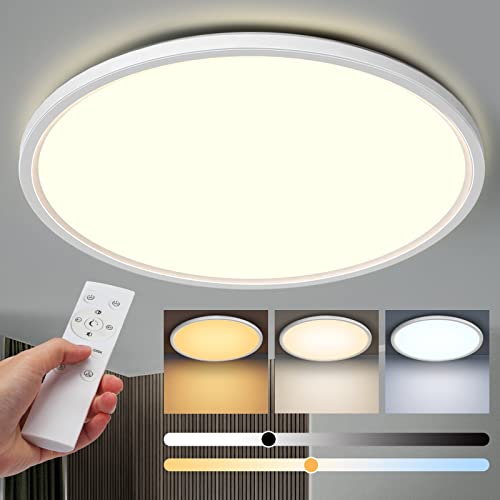
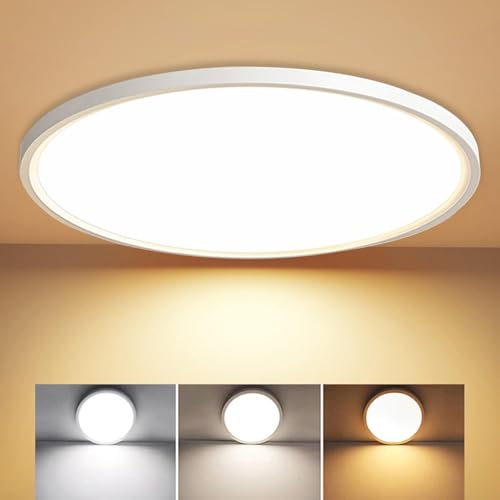
What the source says: 3 colour temperatures selectable: This ceiling light has no dimming function. Please choose your preferred colour temperature before installation by setting the toggle switch on the back of the product. If you want to change to another colour temperature, take the product down and set the slider on the back. You do not even need to use the remote control to have a ceiling light with 3 colour temperatures.(No dimming function & remote control not included).
Why this matters: Check how many ways of operating there really are and whether each of them stays within reach at the planned spot. It also matters whether the device stores the last chosen setting and whether an accidental touch changes a setting. With a remote control, the question of batteries belongs here too. This sentence is the most honest line of the whole listing and the most important purchasing information at the same time. The brightness is fixed, there is only on and off, and the light must never go on a wall dimmer. The register entry confirms this with the entry dimmable: No. Anyone who wants dimmed light in the evening is fundamentally wrong with this model. That is the whole core of this product group in one sentence, and it deserves more attention than it gets. Every later change of colour temperature means: fuse off, check that the circuit is dead, take the light down, change the setting, reconnect and screw it up again. The same bullet point, incidentally, calls the component a toggle switch earlier and a slider here, and no source settles which of the two is fitted. Decide the colour temperature before installation and, if in doubt, try it out on the table first.
Listing detail: 30cm ultra-thin
What the source says: 30cm ultra-thin: Slim and fully enclosed design (diameter 30 cm, height 2.3 cm). This ceiling lamp is made from high-quality ABS material and is distinguished by outstanding durability and reliability. It can brighten up your room nicely and offers comfortable and bright light.
Why this matters: This point should be checked against the dimensions, instructions and existing installation before you buy. A listing can contain variants or shortened wording.
Listing detail: Super energy-saving and widely usable
What the source says: Super energy-saving and widely usable: The Mgeeled 20W LED ceiling light can perfectly replace 180W light bulbs and saves you more than 90% of energy and electricity bills. The LED ceiling lamp offers 2,400 lumens of brightness, which is bright enough and soft enough to light your room. Best choice for bedroom light, bathroom light, kitchen light, office light, hallway light, cellar light, garage light, living room light.
Why this matters: Comparisons and savings figures like these come from the sales text and name neither a reference device nor the calculation. You can only compare reliably through lumens and watts, and against the light that is actually to be replaced. Neither half is quite right. 20 watts instead of 180 watts is a saving of 88.9 per cent and not of more than 90 per cent; for that the replacement wattage would have to be 200 watts. And the brand does not make the equivalence statement officially at all: in the register entry for QH-C30, the line for equivalent power consumption has a dash. For context: 2,400 lumens lie roughly between what a 150-watt and a 200-watt incandescent lamp would have delivered.
Listing detail: IP44 waterproof and safe
What the source says: IP44 waterproof and safe: The bathroom ceiling lamp is IP44 waterproof and fully enclosed design, which is effectively waterproof, mosquito-proof and dust-proof, can also be used for a long time, there will be no shadows, no need to worry about cleaning at all.
Why this matters: The IP rating is a technical limit, but not a blanket approval for every installation location. Zone, connection and the complete installation instructions remain decisive. IP44 is not waterproof. The second digit 4 means protection against splashing water from all directions, and waterproof would only apply from a second digit of 7, that is temporary immersion. The light is not dust-tight either: the first digit 4 protects against solid objects from one millimetre, and dust-tight requires a 6. For the areas in the bathroom outside the shower and bath IP44 is right, directly above the bath it is not.
Listing detail: Flicker-free and eye protection
What the source says: Flicker-free and eye protection: Thanks to the most advanced side-light technology it is flicker-free and offers a display index of up to 85+, which restores the true colour of objects, so that your eyes feel more comfortable, more eye protection.
Why this matters: This statement comes from the sales listing and should not be read as a medical effect. A reliable assessment would need measurement methods and limit values that a shop listing often does not state in full. The data sheet on the same listing page gives 80, as both the minimum and the maximum value. For the rendering of deep red it also gives an R9 value of 3, which is low; red fabrics and wood tones look flatter under this light than they are. 80 is the legal minimum and entirely sufficient for bathroom, hallway and cellar, but it is simply not 85.
Listing statement: Easy installation
What the source says: Easy installation: Installing this ceiling light is uncomplicated and only requires a simple connection to the mains (we provide all the screws needed). The flat LED ceiling light offers enough space for the wiring. The long lifetime of up to 30,000 hours, with no need to change lamps, saves time and maintenance costs.
Why this matters: For the assessment, what counts is whether this feature brings a concrete advantage in daily use. Without a matching lighting task it remains mainly a data sheet point. The second half-sentence is literally correct and means the opposite of what it sounds like. No lamp change is possible, because the LED is fixed in the housing, and the register gives only a slash as the cap type. If a chip or the power supply fails at some point, you replace the complete light, including taking it down and reconnecting it. The detail table of the same listing claims an E27 light bulb cap instead, and that is simply false. This connection is a hard-wired connection to 230 volts without a plug, and the detail table of the same page nevertheless enters No under Assembly required. Before work, switch off the fuse and check that the circuit is dead rather than relying on the light switch. If you are unsure about the terminal, the earth conductor or the condition of the wiring, call in a qualified electrician.
Use in daily life
In this model the light source is permanently installed. There is no holder and no replaceable light bulb, so brightness, colour temperature and the type of dimming are fixed from the factory. At the end of its rated lifetime you therefore replace the complete light and not the lamp. That makes the purchase decision more final than with a light that has a screw-in holder.
For this model, the purchase decision should therefore hinge on a concrete situation. Before buying, write a sentence such as: “I need light for …” and add place, time of day and activity. If the model does not clearly fulfil this task, an alternative from the same category is probably the better choice.
In bathrooms and outdoors, safety comes into play. An IP rating must match the actual installation location. With a hard-wired connection and uncertainty about bathroom zones, a qualified electrician is the right point of contact.
Strengths and limits of the assessment
What speaks for the model
- Product image, ASIN and listing data are clearly linked to one another.
- The design can be matched to a specific lighting task: for bathroom, hallway, cellar or garage when the colour temperature is set once and not touched again, not for rooms where you want to dim in the evening.
- The available features allow a targeted check before buying, without inventing a star rating.
What remains open
- No long-term use of our own, no light measurement and no documented load check.
- Listing details can be abbreviated or change with variants and model updates.
- Room effect, glare and ease of use depend on your location and daily routine.
The typical wrong purchase here is a mistaken expectation: anyone who buys a ceiling light with three colour temperatures and assumes they can switch between them like with a light switch will later be standing on a ladder with the fuse off, because the switch sits on the back and the light has to come down for it. The second breaking point is the advertised core feature itself: the EU product data sheet on the same listing page knows only a single colour value of 2,700 kelvin and not the 3,000, 4,000 and 6,500 kelvin named in the title, and it additionally contradicts itself by listing the light at the same time as colour tuneable. Added to this is the detail table with its invented E27 cap, which suggests you could change the light bulb, although if it fails the whole light goes. Anyone who instead simply needs bright, flicker-free light in a once-chosen colour for a hallway, cellar or bathroom gets, for very little money, a light whose efficiency class and flicker values are backed by a genuine registration.
What you should measure and check before buying
Decide before screwing it up which of the three colour temperatures you want, and set the switch on the back while it is still on the table, because every later change means fuse off and taking the light down. Then measure the ceiling outlet and check whether the terminal point disappears completely under the base plate of around 30 centimetres in diameter and whether there is enough room there for the Wago terminals, because the light is only 22 millimetres high. Look in the fuse box and at the wall to see whether a dimmer sits in the circuit concerned, because this light is expressly not dimmable and belongs on a simple switch. And in the bathroom, check how far the planned position is from the shower or bath, because IP44 covers splashing water, not the area directly above it.
- Define the task: Write down which surface or zone is to be lit and at what time of day you use it.
- Measure the space: Check the mounting surface, cut-out or drilling pattern, the height of the cavity and whether a fixed supply cable is present at the planned location. Product photos are no substitute for dimensions.
- Compare the light data: Check light output, colour temperature, dimming and, if needed, IP rating in the current listing or manual.
- Think through the controls: The switch, app, sensor or remote control must be reachable and understandable in daily use at the planned location.
- Check the variant: Colour, size and set contents can differ within one listing, and often the technical details in the description text with them. Compare the selected variant with this analysis.
If you are unsure how much light your room needs at all, work it out once: the lumens-to-watts chart translates wattage figures into actual brightness, and how many lumens per room are needed depends on area and activity. Further models from this area are in the overview under home lighting, and the lighting calculator translates your room into a concrete target brightness.
Set-up, position and first check
Assign each lamp to exactly one task. Then check colour temperature, controls and possible glare in the evening. For permanently installed lamps, the installation instructions must match the existing connection; improvised solutions are not a good basis.
After set-up, do not judge the light only in daylight. In the evening, switch the rest of the lighting as you normally use it, and check the situation from seated, standing and walking height. Only then do disturbing reflections, hard shadows or an unfavourable switch position become visible.
Keep the instructions and the model designation. This helps with spare parts, with a later query about the product and in a guarantee case. Replacing the light source is not intended; at the end of its rated lifetime the whole device is replaced. For a hard-wired mains connection, damp locations and outdoor mounting, the rule is: if the existing installation does not clearly match the instructions, the work belongs in professional hands.
Comparison with similar models
The comparison does not name winners. It shows models of the same category so that you can see whether one of them is closer to your lighting task. If two models have the same task in the Assessment column, they do not differ in purpose but in design, dimensions and features. The column then states what is actually different according to the sources.
| Model | Brand | Assessment | Details |
|---|---|---|---|
| MGEELED LED ceiling light Ø 30 cm | MGEELED | for bathroom, hallway, cellar or garage when the colour temperature is set once and not touched again, not for rooms where you want to dim in the evening | This review |
| Aisutha LED ceiling light SKCL 300/T | Aisutha | for bedroom, children's room or hallway, if you want to keep at least the colour temperature after losing the remote control, not as a night light and not for the zone above the bath | Read the analysis |
| Swoieltr YLXDD230 flat ceiling light | Swoieltr | for small hallways, storerooms and cellar rooms where a fixed colour temperature and a fixed brightness are enough, not for bathroom and kitchen, and not for rooms where the light may need to change later | Read the analysis |
Our buying decision
MGEELED LED ceiling light Ø 30 cm makes sense if you are looking for a light for bathroom, hallway, cellar or garage where the colour temperature is set once and not touched again, have checked the dimensions at the intended spot and actually use the functions named in the listing. The purchase is less convincing if you expect a universal solution for several conflicting lighting tasks.
Keep looking if key data such as dimensions, light output, IP rating or compatibility is not clearly documented for your intended use. The same applies if you only like the look of the design, but the cable, the installation location or the controls would get in your way in daily use.
We deliberately award no stars. A numerical score would suggest a measurement accuracy that does not exist without documented hands-on testing. The statement this page can support is narrower: which details are available, what the model may be suited for, and which questions remain open before you buy?
Frequently asked questions about the home light
How do I change the colour temperature after installation?
By taking the light down again, and the listing itself says so. The switch for the three colour temperatures sits on the back of the housing, and there is neither a remote control nor a switching sequence at the wall switch. In practice that means: switch off the fuse, check that the circuit is dead, release the light, change the setting, reconnect it. Decide the colour temperature before screwing it up.
Which colour temperatures are actually documented?
None of the three advertised ones. The title and bullet points name 3,000, 4,000 and 6,500 kelvin, but the EU product data sheet on the same listing page enters a single value, namely 2,700 kelvin, and marks it explicitly as a single value. In the same document the light is at the same time ticked as colour tuneable, which is incompatible with a single value. Expect the warmest setting to come out noticeably warmer than the advertised 3,000 kelvin.
Is energy efficiency class D correct?
Arithmetically yes, but it depends on a classification. 2,400 lumens divided by 20 watts is 120 lumens per watt, which would be class E, since D only starts at 135. Only the factor of 1.176 that the regulation provides for directional light at mains voltage lifts the value to 141.1 lumens per watt and so into class D. The peak luminous intensity of 256 candela given in the same data sheet hardly fits a directional light source, though, because even a completely evenly radiating source with 2,400 lumens would reach 191 candela. How much depends on this is shown by the brand itself: its square CX-36W-RD-30K-M is practically level at 119.44 lumens per watt, but is registered as non-directional and is therefore in class E.
Can I connect the light to an existing wall dimmer?
No, under no circumstances. The listing states explicitly that the light has no dimming function, and the register entry confirms this with dimmable: No. A non-dimmable LED light on a dimmer flickers at best and at worst damages the power supply or the dimmer. If your circuit has a dimmer, it must be replaced with a normal switch before installation.
Is the light allowed in the bathroom?
With IP44 yes, but not everywhere in the bathroom. The second digit 4 stands for protection against splashing water from all directions, which is enough for the ceiling above the basin or in the rest of the room. Directly above the shower or bath stricter requirements apply, and despite the advertising claim the light is not waterproof, because that would need a second digit of 7. It is not dust-tight either, which would need a 6 as the first digit.
How bright will a bathroom or hallway be with it?
For a room of around ten square metres, 2,400 lumens is nominally about 240 lux, which is exactly the order of magnitude usually assumed for bathrooms and kitchens. In a narrow hallway the same amount looks much brighter, and in a 15 square metre room it falls arithmetically to around 160 lux, which is plain living-room level. Because the light cannot be dimmed, this is also the only brightness you will ever get.
Sources and currency
The sources are ranked by their closeness to the product: manufacturer documents come before retailer or comparison data. A shop listing is useful for the variant currently on offer, but it is not an independent check. Missing documents are not replaced with invented experiences.
- Listing for ASIN B0DJ4CHK8S: diameter 30 centimetres, height 2.3 centimetres, 20 watts, 2,400 lumens, three colour temperatures 3,000, 4,000 and 6,500 kelvin via a toggle switch on the back, expressly no dimming function and no remote control, ABS housing, IP44, colour rendering index up to 85 plus, flicker-free, replacement for 180-watt light bulbs with more than 90 per cent saving, up to 30,000 hours. The detail table of the same page gives model number QH-C30, energy efficiency class D, 220 volts, switch type toggle switch, dimensions 30 by 30 by 3 centimetres, and, contradicting that, light bulb cap E27, control type touch and light direction uplighter. Amazon listing B0DJ4CHK8S, not linked
- EU product data sheet that Amazon delivers on this listing page behind the energy label, identical in content to EPREL registration 2152713: brand MGEELED, model identifier QH-C30, authorised representative CET PRODUCT SERVICE SP. Z O.O. in Zgierz, 2,400 lumens in the wide cone of 120 degrees at 20.0 watts, class D, directional mains-voltage light source, cap type slash, colour tuneable Yes, dimmable No, connected light source Yes, colour rendering index 80, R9 equals 3, peak luminous intensity 256 candela, half-value angle 120 degrees, displacement factor 0.50, colour consistency 3 MacAdam ellipses, lumen maintenance factor 0.96, survival factor 1.00, flicker metric 0.0, stroboscopic effect metric 0.0, dimensions 296 by 296 by 22 millimetres, placed on the market since 27 September 2024. A single value is entered as the colour temperature, namely 2,700 kelvin.
- The same product on the French market under the same ASIN B0DJ4CHK8S. The address of the listing page carries the model identifier QH-C30 in its path and thereby clearly links the item number of the listing with registration 2152713. The details there are identical: 30 centimetres, 20 watts, 2,400 lumens, three colour temperatures 3,000, 4,000 and 6,500 kelvin, IP44.
- The four further MGEELED entries in the EU product register as a yardstick from the same house. Registration 2805745, model identifier QH-C40: 3,600 lumens at 30 watts, so likewise 120.00 lumens per watt, directional, class D, peak luminous intensity 688 candela, colour rendering index 90, dimmable Yes. Registration 1781055, CX-36W-RD-30K-M: 4,300 lumens at 36 watts, so 119.44 lumens per watt, non-directional, class E. Registration 1593650, CX-36W-RD-40K-M: 4,250 lumens at 36 watts, so 118.06 lumens per watt, non-directional, class E. Registration 1318279, FCY30: 3,200 lumens at 30 watts, non-directional, class F. Three of the five lights are registered as non-directional, and only the two round QH models are directional.
- For comparison, the register entry of a ceiling light of the same size from the same authorised representative, number 1437678, brand Aisutha, model identifier SKCL 300/T: 2,771 lumens at 24 watts, class D, colour rendering index 83, R9 equals 12, displacement factor 0.90, peak luminous intensity 1,632 candela, dimmable Yes. The same registration body enters a displacement factor of 0.90 there, while for the MGEELED light it reports 0.50.
- Delegated Regulation (EU) 2019/2015 in full text. Annex II and Annex III: total mains efficacy equals useful luminous flux divided by power consumption times the factor from Table 2, which is 1.000 for non-directional light at mains voltage and 1.176 for directional light at mains voltage; class D runs from 135 to below 160 lumens per watt, class E from 110 to below 135. A light source counts as directional only if it emits at least 80 per cent of its luminous flux into a solid angle of pi steradians, that is a cone of 120 degrees.
- Amazon product listing B0DJ4CHK8S; product data via the Creators API, retrieved 13 August 2026 Advertisement
Content checked on 13 August 2026. Prices, availability and product variants may change independently of this page. For the final check, always use the current retailer listing and any available manufacturer documents.
If a linked source is no longer reachable, or the model on offer visibly differs from the product image and designation, this analysis is no longer the right basis for a decision. In that case the current model number is what counts. Tell us about the difference via the contact page (in German), so that the data, the link and the recommendation can be checked.