Does the model suit your lighting task?
ASJK ceiling light 80 cm, angular geometric, colour temperature 3,000 to 6,000 kelvin via… stands in this selection for basic lighting in a larger living space at an existing ceiling rose, with contradictory luminous flux claims and without a manufacturer document. That is a narrower and more honest statement than a blanket “good” or “bad”. A lamp can be technically decent and still disappoint in the wrong place. That is why this review starts with the intended use, not with a score.
What matters is the luminous flux per square metre. 5,400 lumens over 20 square metres is 270 lumens per square metre, over 30 square metres 180, in each case before losses. With 60 watts that gives 90 lumens per watt, with the 6,000 lumens 100, both class F at factor 1.000 for non-directional light on mains voltage.
For this model there are 5 readable product features from the Amazon listing. They are not presented as independently confirmed measured values. We explicitly separate what the source states from our practical assessment. We do not claim any long-term, laboratory or room trials of our own. We reproduce the quoted listing texts unchanged in content, but apply the house style for punctuation: dashes become a colon or comma, ranges are written out with “to”, and special characters and advertising symbols are removed. Numbers, units and statements are left untouched.
Product data and sources
| Product | ASJK ceiling light 80 cm, angular geometric, colour temperature 3,000 to 6,000 kelvin via… |
|---|---|
| Brand | ASJK |
| Category | Home lighting |
| ASIN | B0D35H3YN4 |
| Sources as of | 2 November 2026 |
| Type of research | Data and source analysis; no laboratory or long-term trial of our own |
Listing claim: Living room ceiling lamp
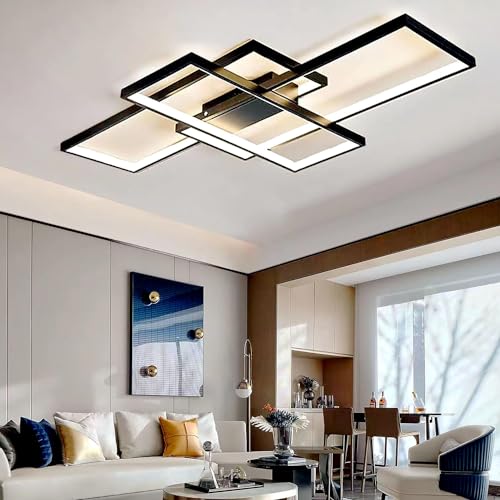
What the source states: Living room ceiling lamp: The LED ceiling lamp Asjk impresses with its geometric design, because it consists of three overlapping rectangles. Thanks to the 3-step dimming technology with integrated off function, it can also be dimmed into three different levels by pressing the switch several times.
Why this matters: Dimmable is only a usable statement once the way of operating it and the steps are clarified. With a built-in LED, the electronics in the device alone decide, and an upstream wall dimmer is neither needed nor intended here. The first bullet point describes three-step dimming via the wall switch, the fourth point control of brightness and colour temperature by remote control. The listing does not explain how the two relate. Smooth dimming is therefore not substantiated.
Listing claim: Large LED living room ceiling light
What the source states: Large LED living room ceiling light: The LED ceiling light with 60W energy saving and 5,400LM light output can supply every room with sufficiently super bright light, to ensure the ideal lighting for the LED ceiling lamp. (60W = 6,000lm, 82W = 8,200lm, 105W = 10,500lm)
Why this matters: The amount of light can only be assessed together with beam angle, distance and the area being lit. A high figure alone does not say whether the light arrives in the right place. In the same paragraph the bracket says 60W = 6,000lm. Both figures apply to 60 watts, and they cannot both be right. 5,400 lumens give 90 lumens per watt, 6,000 lumens give 100 lumens per watt, both class F at factor 1.000. Plan cautiously with 5,400 lumens.
Listing claim: The living room ceiling lamp uses high-quality aluminium…
What the source states: The living room ceiling lamp uses high-quality aluminium and a silicone lampshade shell with a light surface. Thanks to the higher light transmission, the light is distributed evenly in the room, so that your eyes feel more comfortable. High-quality LED ceiling lights can directly replace 150W incandescent lamps, which are very energy saving and can save you more than 90% of the electricity bill.
Why this matters: For the assessment, what counts is whether this feature brings a concrete advantage in everyday use. Without a matching lighting task it remains mainly a data sheet point. The calculation does not add up with the listing's own figures. 60 watts instead of 150 watts is 60 percent less power on this one light, not more than 90 percent. The total electricity bill of a household consists of many other consumers. Equivalence claims for incandescent lamps are tied to fixed lumen values in Regulation (EU) 2019/2015. Whether the claim fits this light depends on the actual luminous flux, and that is contradictory in the listing. The claim is not substantiated.
Listing claim: Dimmable LED ceiling light with remote control
What the source states: Dimmable LED ceiling light with remote control: The LED's straight-lined design gives the light a dynamic look and makes it a real eye-catcher. Colour temperature: 3,000K, 4,500K, 6,000K, the brightness can be changed (via remote control). The CRI index of the ceiling light is greater than 80, the colour rendering is high and the vivid and natural light allows us to see the most real and original colour of the object.
Why this matters: Check how many ways of operating it there really are and whether each of them stays reachable at the planned spot. It also matters whether the device stores the last chosen level and whether an accidental touch changes a setting. With a remote control, the question of batteries belongs here too.
Listing claim: Order now and 2 years Asjk purchase guarantee, if you have questions…
What the source states: Order now and 2 years Asjk purchase guarantee, if you have questions please feel free to contact us. Customer service with a quick reply within 24 hours.
Why it matters: This is a promise by the seller from the listing text, not manufacturer evidence and not an additional legal right. Your statutory consumer rights apply regardless. A voluntary guarantee only counts once its conditions are available in writing.
Use in daily life
In practice, space, fixing, connection and operation count. The light measures 80 centimetres, the listing states no installation height, and a register entry for the brand gives 100 millimetres. It hangs at the ceiling rose without a plug, and according to the listing it is operated by remote control or in three steps via the wall switch.
For this model, the purchase decision should therefore hinge on a concrete situation. Before buying, write a sentence such as: “I need light for …” and add place, time of day and activity. If the model does not clearly fulfil this task, an alternative from the same category is probably the better choice.
According to the listing, the light is not built for a bathroom, damp room or outdoor area, because an IP rating is missing. As worktop lighting in the kitchen it is not substantiated. The light of the colour temperatures does not replace medical light treatment, and effect promises about the comfort of the eyes are not substantiated.
Strengths and limits of the assessment
What speaks for the model
- Product image, ASIN and listing data are clearly linked to one another.
- The design can be matched to a specific lighting task: for basic lighting in a larger living space at an existing ceiling rose, with contradictory luminous flux claims and without a manufacturer document.
- The available features allow a targeted check before buying, without inventing a star rating.
What remains open
- No long-term use of our own, no light measurement and no documented load check.
- Listing details can be abbreviated or change with variants and model updates.
- Room effect, glare and ease of use depend on your location and daily routine.
The purchase most often fails on expectations that the listing itself does not cover: 6,000 or even 10,000 lumens, smooth dimming via a wall dimmer, a flat design. If you plan 5,400 lumens for a room over 30 square metres, you will find it gloomy. Without a manufacturer document there is no manual and no verified dimmer list.
What you should measure and check before buying
Before buying, measure the installation height at the target location, because the listing states none, and check whether the ceiling carries the 80 centimetre width and the weight of the aluminium light. Clarify with the seller which of the two dimming methods (wall switch in three steps or remote control) your variant has. Calculate your floor area against 5,400 lumens, not against the higher figures.
- Clarify the task: Clarify whether you need a large basic light or a light with smooth dimming. Those are two different classes of device.
- Measure the ceiling: Measure the installation height, the width of 80 centimetres and the load capacity of the ceiling at the target location.
- Plan the luminous flux: Divide 5,400 lumens by your floor area and compare with your need.
- Clarify the operation: Ask whether the wall switch in three steps or the remote control applies, and whether a wall dimmer is permitted.
- Check the variant: Match wattage, size and colour against the listing, because the model identifier is not stated there.
If you are unsure how much light your room needs at all, work it out once: the lumens-to-watts chart translates wattage figures into actual brightness, and how many lumens per room are needed depends on area and activity. Further models from this area are in the overview under home lighting, and the lighting calculator translates your room into a concrete target brightness.
Set-up, position and first check
For the connection, the ceiling rose counts: it must carry the plate and the weight, and a fixed 230 volt connection is, in case of doubt, a job for a qualified electrician. Then check whether the remote control is paired and which dimming steps are really present.
After set-up, do not judge the light only in daylight. In the evening, switch the rest of the lighting as you normally use it, and check the situation from seated, standing and walking height. Only then do disturbing reflections, hard shadows or an unfavourable switch position become visible.
Note the model number and order date and keep whatever paperwork is in the box. For this item there is neither a manual nor a manufacturer page to download, and in the event of a complaint the retailer is the only point of contact. In a warranty claim, both are the only proof of which device you bought. Replacing the light source is not provided for, and at the end of its rated lifetime the complete device is replaced. This device is intended for indoor use only and is not approved for damp rooms or outdoor use.
Comparison with similar models
The comparison does not name winners. It shows models of the same category so that you can see whether one of them is closer to your lighting task. If two models have the same task in the Assessment column, they do not differ in purpose but in design, dimensions and features. The column then states what is actually different according to the sources.
| Model | Brand | Assessment | Details |
|---|---|---|---|
| ASJK ceiling light 80 cm, angular geometric, colour temperature 3,000… | ASJK | for basic lighting in a larger living space at an existing ceiling rose, with contradictory luminous flux claims and without a manufacturer document | This review |
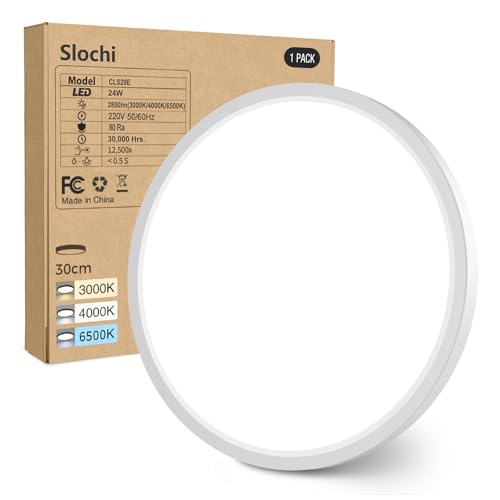
| slochi flat round ceiling light | slochi | for basic lighting in a hallway, kitchen or bathroom at an existing ceiling rose, without a substantiated IP rating and without substantiated dimming | Read the review |
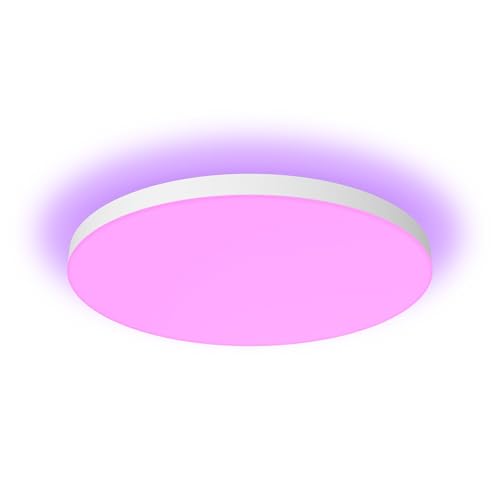
| Philips Hue Datura ceiling light 57.4 cm round | Philips Hue | for a living room, bedroom or kitchen with an existing ceiling rose and smart home control, not for a bathroom or damp room and not for low rooms | Read the review |
Our buying decision
ASJK ceiling light 80 cm, angular geometric, colour temperature 3,000 to 6,000 kelvin via… makes sense if you are looking for a light for basic lighting in a larger living space at an existing ceiling rose, with contradictory luminous flux claims and without a manufacturer document, have checked the dimensions at the intended location and actually use the functions named in the listing. Buying is less convincing if you expect a universal solution for several contradictory lighting tasks.
Keep looking if key data such as dimensions, light output, IP rating or compatibility is not clearly documented for your intended use. The same applies if you only like the look of the design, but the cable, the installation location or the controls would get in your way in daily use.
We deliberately award no stars. A numerical score would suggest a measurement accuracy that does not exist without documented hands-on testing. The statement this page can support is narrower: which details are available, what the model may be suited for, and which questions remain open before you buy?
Frequently asked questions about the ceiling light
How bright is the ASJK ceiling light with 60 watts really?
That cannot be said with certainty from the documents. The listing states 5,400 lumens and, in the same paragraph, 6,000 lumens, and a register entry for the brand gives 10,827 lumens at 55.1 watts for a different or stronger model. Plan with the 5,400 lumens, then you are on the safe side.
Which energy efficiency class does the light have?
The listing states no class. With the listing figures and the factor 1.000 for non-directional light on mains voltage, the result is class F (90 to 100 lumens per watt). The only ASJK entry in the EU register (model 8801) is in class B, but is not shown to belong to this listing.
Can the light be dimmed, and with what?
Yes according to the listing, using the supplied remote control, which also adjusts the colour temperature between 3,000 and 6,000 kelvin. In addition, the first bullet point describes three-step switching via the wall switch. A wall dimmer is not mentioned, and there is no list of compatible dimmers.
How tall is the light, and does it fit under a low ceiling?
The listing only states 80 centimetres of width, no height. Register entry 8801 gives 100 millimetres of height and 90 millimetres of depth, but does not prove that it belongs to this listing. Measure the height on your model before you buy for ceiling heights under 2.40 metres.
Can I connect the light myself?
A light without a plug is connected permanently to the ceiling rose, and a fixed 230 volt connection is, in case of doubt, a job for a qualified electrician. We did not find a manufacturer's manual. Switch off the circuit breaker before touching anything.
Is the light suitable for a bathroom or kitchen?
The listing states no IP rating. An IP rating is needed for damp rooms and it is missing here, so the light is only substantiated for dry living spaces. In the kitchen it is enough as basic lighting, not as worktop lighting.
Sources and currency
The sources are ranked by their closeness to the product: manufacturer documents come before retailer or comparison data. A shop listing is useful for the variant currently on offer, but it is not an independent check. Missing documents are not replaced with invented experiences.
- Listing for ASIN B0D35H3YN4 (retrieved on 2 November 2026) with all supplier details: size 80 centimetres, colour black, nominally 60 watts, colour temperature 3,000, 4,500 and 6,000 kelvin, colour rendering index greater than 80, remote control. The listing states two different luminous fluxes (5,400 lumens in the running text, 6,000 lumens in the bracket) and two different ways of operating the dimming. It states no model identifier, energy efficiency class, EPREL number, installation height or IP rating. Amazon listing B0D35H3YN4, not linked
- Register entry in the EU product database EPREL (retrieved on 2 November 2026) under the trade brand ASJK, model identifier 8801, registration number 2006477, published on 22 April 2024 through eVatmaster Consulting GmbH: 10,827 lumens at 55.1 watts, class B, non-directional (NDLS) on mains voltage (MLS), dimmable, colour rendering index 86, colour temperatures 3,000 and 6,000 kelvin, dimensions 800 millimetres width, 100 millimetres height, 90 millimetres depth. This is the only ASJK registration in the register. Whether it describes exactly this listing is stated nowhere: the model identifier 8801 does not appear in the listing.
- Regulation (EU) 2019/2015 on energy labelling of light sources (retrieved on 2 November 2026). Annex II sets the class limits for total mains efficacy: from 85 lumens per watt class F, from 110 E, from 135 D, from 160 C, from 185 B, from 210 A. The correction factor is 1.000 for non-directional light on mains voltage, 1.176 for directional light on mains voltage.
- Amazon product listing B0D35H3YN4; product data via the Creators API, retrieved 2 November 2026 Advertisement
Content checked on 2 November 2026. Prices, availability and product variants can change independently of this page. For the final check, always use the current retailer listing and any available manufacturer documents.
If a linked source is no longer reachable, or the model on offer visibly differs from the product image and designation, this analysis is no longer the right basis for a decision. In that case the current model number is what counts. Tell us about the difference via the contact page (in German), so that the data, the link and the recommendation can be checked.