Does the model suit your lighting task?
Mojimdo HPL601RF daylight floor lamp stands in this selection for bright room light next to a seat or desk. It is not intended for a light therapy use with verifiable illuminance. That is a narrower and more honest statement than a blanket “good” or “bad”. A lamp can be technically sound and still disappoint in the wrong place. That is why this review starts with the intended use, not with a score.
Declared are 3456 lumens of useful luminous flux at 16.0 watts in a wide cone of 120 degrees. Such a cone covers about 3.14 steradians, and 3456 divided by 3.14 gives roughly 1100 candela of mean luminous intensity. Illuminance is the luminous intensity divided by the square of the distance: about 27,500 lux at 0.2 metres, 12,200 lux at 0.3 metres, 4400 lux at 0.5 metres and 1100 lux at one metre. The 20,000 lux from the product name is therefore reached at about 23 centimetres from the lamp head.
For this model, 4 readable product features are available from the Amazon listing. They are not presented as independently confirmed measured values. We separate explicitly between what the source states and our practical assessment. We do not claim any long-term, laboratory or room trial of our own. We reproduce the quoted listing texts unchanged in content, but apply the house punctuation: dashes become a colon or comma, ranges of values are written out with “to”, and special characters and promotional symbols are removed. Numbers, units and statements remain untouched.
Product data and sources
| Product | Mojimdo HPL601RF daylight floor lamp |
|---|---|
| Brand | Mojimdo |
| Category | SAD lamps |
| ASIN | B0CXHNLLB5 |
| Sources as of | 27 August 2026 |
| Type of research | Data and source analysis; no laboratory or long-term trial of our own |
Listing statement: 20000 Lux bright light:, This lamp simulates natural…
What the source says: 20000 Lux bright light:, This lamp simulates natural daylight with a full spectrum and offers 20,000 lux for effective light therapy.
Why this matters: A lux figure must always come with the measuring distance. As the distance grows, markedly less illuminance arrives at the eye or on the work surface. The listing gives no measuring distance for this figure, and without a distance a lux figure can be neither verified nor compared. The value can be recalculated from the product data sheet: 3456 lumens in a 120 degree cone give about 1100 candela of mean luminous intensity, and 20,000 lux is therefore only reached at about 23 centimetres from the lamp head. At 0.5 metres it is about 4400 lux, at one metre about 1100 lux. With a floor lamp 1.70 metres tall, nobody sits at 23 centimetres.
Listing statement: Dimmable and adjustable:, With 5 colour temperatures and 10…
What the source says: Dimmable and adjustable:, With 5 colour temperatures and 10 brightness levels you can adjust the light individually. The flexible gooseneck lets you aim the light at the optimal angle.
Why this matters: The stated colour temperature describes the effect, not the brightness. In daily use, what matters is whether fixed steps or a smooth range are offered and whether the setting is saved. Both contradict the mandatory details from the same supplier. The product data sheet under Regulation (EU) 2019/2015 and both EPREL entries list the light source as not dimmable and not colour tuneable. All that is declared is a colour temperature range of 3000 to 6000 kelvin. Which of the two statements is correct cannot be settled without a manufacturer document, and none exists for this model.
Listing statement: Energy-efficient LEDs:, This lamp uses long-lasting…
What the source says: Energy-efficient LEDs:, This lamp uses long-lasting, energy-efficient LEDs that provide even light and use less power. It reduces glare and prevents eye strain. Light and elegant, ideal for use at home and in the office.
Why this matters: For the assessment, what counts is whether this feature brings a concrete benefit in daily use. Without a matching lighting task, it remains mainly a data sheet item. This is, unusually, the documented part of the listing, but it deserves a closer look. Declared are 3456 lumens at 16.0 watts, which is 216 lumens per watt and therefore class A, which starts at 210 lumens per watt under the regulation. This value is at the upper end of what LED technology achieves, while typical home lamps land at 90 to 130 lumens per watt. Note that the luminous flux in the data sheet is declared only for a 120 degree cone, although the light source was ticked there as non-directional at the same time. There is no figure and no document for the glare statement. The product data sheet explicitly reports that no anti-glare shield is present. Around 1100 candela of mean luminous intensity from a movable gooseneck is exactly the situation in which glare arises as soon as the head is in the field of view. At least flicker and stroboscopic effects are declared low, at 0.1 each.
Listing statement: Simple operation:, Intuitive touch controls…
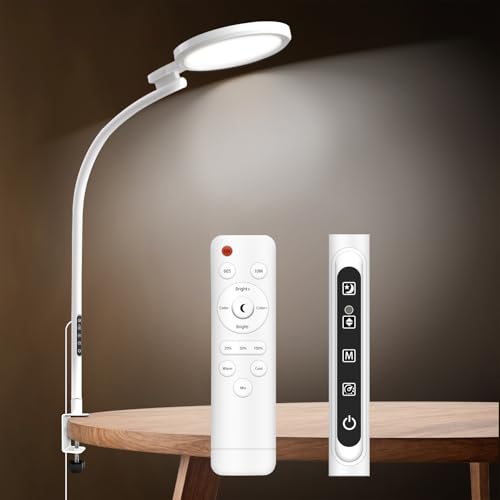
What the source says: Simple operation:, Intuitive touch controls and a smart remote control provide convenient operation. The simple setup process makes the lamp user-friendly for all age groups and ensures trouble-free operation.
Why this matters: Check how many ways of operating it there really are and whether each of them stays reachable at the planned spot. It also matters whether the device stores the last chosen level and whether an accidental touch changes a setting. With a remote control, the question of batteries belongs here too.
Use in daily life
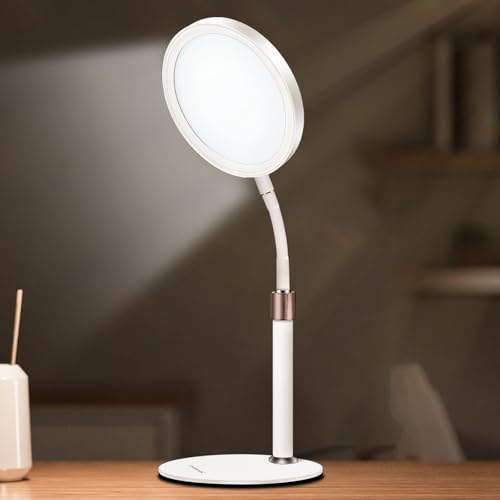
In daily use the floor counts, not the table. The lamp measures 230 by 230 by 1700 millimetres and weighs a good two kilograms, so it needs free floor space next to an armchair or desk and a cable route to the socket, because it runs on mains voltage and has no battery. It is operated via a touch surface and a remote control. The gooseneck is the real lever: only with it can you bring the head down far enough for the light to land where you need it.
For this model, the purchase decision should therefore hinge on a concrete situation. Before buying, write a sentence such as: “I need light for …” and add place, time of day and activity. If the model does not clearly fulfil this task, an alternative from the same category is probably the better choice.
This device does not deliver documented light use, and that is not down to the technology but to the missing documents. There is no manufacturer website, no manual, no recommended duration and no measuring distance. Anyone who wants use according to instructions needs a model that states illuminance and distance together. Light use also does not replace medical treatment, and eye conditions, photosensitising medication and mental health conditions should be clarified with a professional beforehand.
Strengths and limits of the assessment
What speaks for the model
- Product image, ASIN and listing data are clearly linked to one another.
- The design can be assigned to a specific lighting task: for bright room light next to a seat or desk, not for a light therapy use with verifiable illuminance.
- The available features allow a targeted check before buying, without inventing a star rating.
What remains open
- No long-term use of our own, no light measurement and no documented load check.
- Listing details can be abbreviated or change with variants and model updates.
- Room effect, glare and ease of use depend on your location and daily routine.
This purchase fails because the name and the design do not match. Anyone expecting a compact SAD lamp for the desk gets a floor lamp 1.70 metres tall, and by the calculation from the product data sheet the 20,000 lux only applies at about 23 centimetres from the lamp head. The second trap is the functions: dimming and colour temperature changes appear in the listing but not in the mandatory details of the same supplier, and there is no manufacturer document to settle it. And if something goes wrong later, you will find neither a manual nor a spare part nor a contact, because the brand domain is now only for sale.
What you should measure and check before buying
First measure the floor space and the route to the nearest socket, because this device is 1.70 metres tall and is not meant to stand on a desk. Then measure the distance between your head at the planned seat and the spot where the lamp head would stand, and match it to the calculation: about 12,200 lux at 0.3 metres, about 4400 lux at 0.5 metres, about 1100 lux at one metre. Also check whether the gooseneck reaches far enough down in your sitting posture that the head is not directly in your field of view. And decide before buying whether you want room light or documented light use, because the latter is not delivered by this device for lack of a manual.
- Clarify the task: First decide whether you need bright room light or light use according to a manual. These are two different device classes, and this model brings no instructions for the second.
- Measure height and floor space: Allow for 230 by 230 by 1700 millimetres, and check the free floor area next to the seat and the route to the socket.
- Place the distance: Measure the distance from your head to the planned lamp head and match it: about 4400 lux at 0.5 metres, about 1100 lux at one metre.
- Check glare: No anti-glare shield is declared. From seated height, check whether the head of the lamp is directly in your field of view.
- Match the version: The model codes HPL601RF-WH and HPL601RF-BK exist, with identical register values. Match the chosen colour and the model number before ordering.
If you are unsure how much light your room needs at all, work it out once: the lumens-to-watts chart translates wattage figures into actual brightness, and how many lumens per room you need depends on floor area and activity. More models in this area are listed in the overview of SAD lamps, and the lighting calculator turns your room into a concrete target brightness.
Set-up, position and first check
Place the lamp so that the base is not in the walking path and the cable does not run across the room. Then align the gooseneck from your actual sitting posture and check whether the lamp head is in your field of view, because according to the product data sheet there is no anti-glare shield. Go through the remote control once in peace before relying on a particular button. And judge the light in the evening with the ceiling lighting switched off, because only then do reflections and hard shadows become visible.
After set-up, do not judge the light only in daylight. In the evening, switch the rest of the lighting as you normally use it, and check the situation from seated, standing and walking height. Only then do disturbing reflections, hard shadows or an unfavourable switch position become visible.
Keep the instructions and the model designation. That helps with spare parts, with a later query about the product and in a guarantee claim. Replacing the light source is not intended; at the end of its life the complete device is replaced. This device is intended for indoor use only and is not approved for damp rooms or outdoors.
Comparison with similar models
The comparison does not name winners. It shows models of the same category so that you can see whether one of them is closer to your lighting task. If two models have the same task in the Assessment column, they do not differ in purpose but in design, dimensions and features. The column then states what is actually different according to the sources.
| Model | Brand | Assessment | Details |
|---|---|---|---|
| Mojimdo HPL601RF daylight floor lamp | Mojimdo | for bright room light next to a seat or desk, not for light use with verifiable illuminance | This review |
| Trayvespace SAD lamp with gooseneck, 12 W | Trayvespace | for bright light use without a documented measuring distance | Read the review |
| Trayvespace clamp-on SAD lamp 18 W | Trayvespace | for bright task lighting at the desk, not classed as a medical device | Read the review |
Our buying decision
Mojimdo HPL601RF daylight floor lamp makes sense if you are looking for a lamp for bright room light next to a seat or desk, have checked the dimensions at the intended spot and will actually use the functions named in the listing. The purchase is less convincing if you expect a universal solution for several conflicting lighting tasks.
Keep looking if key data such as dimensions, light output, IP rating or compatibility is not clearly documented for your intended use. The same applies if you only like the look of the design, but the cable, the floor space or the controls would get in your way in daily use.
We deliberately award no stars. A numerical score would suggest a measurement accuracy that does not exist without documented hands-on testing. The statement this page can support is narrower: which details are available, what the model may be suited for, and which questions remain open before you buy?
Frequently asked questions about the Mojimdo floor lamp
Can 20,000 lux be verified for this lamp?
Only indirectly, because the listing gives no measuring distance. From the product data sheet you can calculate: 3456 lumens in a 120 degree cone give about 1100 candela, and from that follow roughly 27,500 lux at 0.2 metres, 12,200 lux at 0.3 metres and 4400 lux at 0.5 metres. The 20,000 lux is therefore reached at about 23 centimetres from the lamp head. That is a distance nobody sits at in daily use with a 1.70 metre tall floor lamp.
Is this a table lamp or a floor lamp?
A floor lamp. The listing's attribute table gives 18 by 18 by 170 centimetres, the product data sheet 230 by 230 by 1700 millimetres, and elsewhere in the listing the lamp appears as Mojimdo 20000 Lux Stehlampe. The product name in the title, by contrast, suggests a compact light. Plan for floor space, for the cable route to the socket and for a lamp head above the eye level of a seated person.
Is energy class A correct?
By calculation, yes. 3456 lumens at 16.0 watts are declared, which gives 216 lumens per watt, and class A starts at 210 lumens per watt under Regulation (EU) 2019/2015. The value is, however, at the upper end of what LED technology achieves at all. Note also that the luminous flux is reported only for a 120 degree cone, although the data sheet ticks the light source as non-directional on the same form.
Is the lamp dimmable, and can it change colour temperature?
The sources contradict each other here. The listing sells 10 brightness levels and 5 colour temperatures, while the product data sheet and both EPREL entries list the light source as not dimmable and not colour tuneable, yet report a colour temperature range of 3000 to 6000 kelvin. No manufacturer document that would settle the point exists for this model. Clarify this before ordering, in the current listing or with the seller.
Is there a manual or a manufacturer website?
No. The domain mojimdo.com does resolve, but it does not host a brand: it redirects to a domain sales page on which the address itself is offered for sale. There is no download area, no manual, no data sheet beyond the legally required information and no instructions for use. Anyone looking for a recommended duration of use will not find one for this model anywhere.
Is the device a medical device?
No statement on this can be found. Neither a manufacturer website nor a declaration of conformity could be found for this model, and the only documents are the mandatory energy-law details, which say nothing on the question. Classification as a medical device can therefore be neither confirmed nor ruled out here. Light use does not replace medical treatment, and eye conditions, photosensitising medication and mental health conditions should be clarified with a professional beforehand.
Sources and currency
The sources are ranked by their closeness to the product: manufacturer documents come before retailer or comparison data. A shop listing is useful for the variant currently on offer, but it is not an independent check. Missing documents are not replaced with invented experiences.
- Listing page for ASIN B0CXHNLLB5. Seller statements: 20,000 lux for effective light use, full spectrum, 5 colour temperatures, 10 brightness levels, timer, flexible gooseneck, touch control and remote control. A measuring distance is missing entirely, as are lumens, watts and a duration of use. The attribute table gives model number HPL601RF, product dimensions 18 by 18 by 170 centimetres at 2.12 kilograms, corded operation and energy class A. The second and third bullet points of the listing are word-for-word duplicates. Elsewhere in the listing the lamp appears as Mojimdo 20000 Lux Stehlampe. Amazon offer B0CXHNLLB5, not linked
- EU energy label as stored with the listing. It shows the trade mark Mojimdo, the model code HPL601RF-WH, energy efficiency class A and an energy consumption of 16 kilowatt hours per 1000 hours of operation.
- Product data sheet under Regulation (EU) 2019/2015, stored with the listing. Trade mark Mojimdo, model code HPL601RF-WH, supplier address ENIFPEGASUSSRL in Bucharest. Declared: LED, non-directional light source, operation on mains voltage, not colour tuneable, not dimmable, no anti-glare shield, 16 kilowatt hours per 1000 hours, class A, useful luminous flux 3456 lumens in a wide cone of 120 degrees, colour temperature 3000 to 6000 kelvin, power consumption 16.0 watts, standby 0.00 watts, colour rendering index 81, R9 value equal to 6, external dimensions 230 by 230 by 1700 millimetres, displacement factor 0.50, flicker metric 0.1. EPREL registration number 1974154, supplier ENIF PEGASUS S.R.L. as authorised representative, customer service via a private freemail address and a Romanian telephone number.
- EU product register EPREL, entry 1974154 for the trade mark Mojimdo, model code HPL601RF-WH. Declared are 3456 lumens at 16 watts power consumption, energy efficiency class A, mains-voltage light source, not dimmable, not colour tuneable, colour temperature range 3000 to 6000 kelvin, colour rendering index 81, dimensions 230 by 230 by 1700 millimetres. The date of placing on the market is declared as 8 May 2025.
- EU product register EPREL, entry 1974163 of the same trade mark for the black version HPL601RF-BK. The values are identical: 3456 lumens, 16 watts, class A, 3000 to 6000 kelvin, colour rendering index 81, 230 by 230 by 1700 millimetres. The date of placing on the market is declared as 9 May 2025.
- The domain mojimdo.com resolves but does not host a brand: the visit redirects via an intermediate step to a domain sales page on which the address itself is offered for sale. A brand site, a data sheet, a manual, a download area or a contact for the manufacturer do not exist there.
- licht.de on the energy efficiency classes of light sources that have applied since 1 September 2021, with the class limits of luminous efficacy: A from 210 lumens per watt, B from 185 to 209, C from 160 to 184, D from 135 to 159, E from 110 to 134, F from 85 to 109 and G below 85 lumens per watt.
- Amazon product listing B0CXHNLLB5; product data via the Creators API, retrieved 27 August 2026 Advertisement
Content checked on 27 August 2026. Prices, availability and product variants can change independently of this page. For the final check, always use the current retailer listing and any available manufacturer documents.
If a linked source is no longer reachable, or the model on offer visibly differs from the product image and designation, this analysis is no longer the right basis for a decision. In that case the current model number is what counts. Tell us about the difference via the contact page (in German), so that the data, the link and the recommendation can be checked.