Does the model suit your lighting task?
INTELAMP solar floodlight YL005-10EP stands in this selection for short, bright bursts of light on movement on a genuinely sunny wall in the summer half of the year. It is not intended as reliable continuous lighting and not for the dark half of the year. That is a narrower and more honest statement than a blanket “good” or “bad”. A lamp can be technically decent and still disappoint in the wrong place. That is why this analysis starts with the intended use, not with a score.
Outdoors, different standards apply than in a living space. There are no walls and no ceiling to reflect light, so a large part of the light simply disappears into the dark. A light that counts as bright in a room quickly looks like a glimmer in the garden. Conversely, outdoors every unshielded light source immediately stands out as a glare point, because the eye is adapted to the dark.
For this model there are 5 readable product features from the Amazon listing. They are not presented as independently confirmed measured values. We explicitly separate what the source states from our practical assessment. We do not claim any long-term, laboratory or room trials of our own. We reproduce the quoted listing texts unchanged in content, but apply the house style for punctuation: dashes become a colon or comma, ranges are written out with “to”, and special characters and advertising symbols are removed. Numbers, units and statements are left untouched.
Product data and sources
| Product | INTELAMP solar floodlight YL005-10EP |
|---|---|
| Brand | INTELAMP |
| Category | Home lighting |
| ASIN | B0C936DKZ5 |
| Sources as of | 26 August 2026 |
| Type of research | Data and source analysis; no laboratory or long-term trial of our own |
Listing claim: Motion sensor with long range
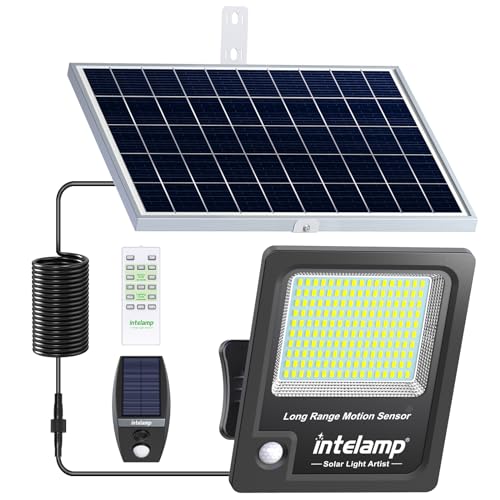
What the source says: [Motion sensor with long range] Every intelamp solar outdoor lamp has an independent motion sensor that lights up in advance within 100 feet when someone approaches the sensor. The sensors of the solar outdoor lights keep the light at high brightness until the person leaves. In addition, the intelamp solar lamp with motion sensor sends a signal to trigger the same intelamp solar outdoor lights within 100 feet and switch to high brightness.
Why this matters: With a sensor, detection angle, range, mounting height and possible false triggers all count. These points cannot be fully derived from a bare mention of the function. The 100 feet are assigned wrongly here. The manufacturer's manual gives 30 metres, so around 100 feet, as the range of the wireless link between the separate sensor unit and the lights, not as the range of the motion detection. For the detection itself, the manufacturer shop gives 26 feet, so just under 8 metres, and a section of the German image gallery gives 25 metres. Calculate with the smallest of these figures and you will not be disappointed.
Listing claim: High brightness and long lighting time
What the source says: [High brightness and long lighting time] intelamp solar lamp with motion sensor With a solar panel with a high conversion rate of 22.5% and a safe 12000mAh battery, the intelamp solar lamps can be fully charged within 5 hours in strong sunlight to provide sufficient power. When fully charged it lasts 4 hours at a brightness of over 2000 LM. And when nobody is nearby, it maintains a brightness of 400 LM in an area of 1000 square feet, which is brighter than moonlight. A fully charged intelamp solar light with motion sensor can last up to 40 hours and also lights for 4 hours without sunlight.
Why this matters: This is a promise by the seller from the listing text, not manufacturer documentation and no additional legal position. Your statutory rights apply regardless. A voluntary guarantee only counts once its terms are available in writing. The battery holds 12,000 milliamp hours at 3.2 volts, so 38.4 watt hours. At a luminous efficacy of around 100 lumens per watt, realistic for this design, 2,000 lumens cost about 20 watts, and 20 watts over 4 hours would be 80 watt hours, more than double the store. The calculation only works out if the 250 lumens per watt claimed in the listing are right, and those would lie above the highest energy efficiency class A of Regulation (EU) 2019/2015, which starts at 210 lumens per watt. Plan for clearly shorter bright phases accordingly. This claim refutes itself with the listing's own figures. 38.4 watt hours divided by 40 hours gives 0.96 watts continuous power, and if the 400 lumens named in the same sentence are to come out of that, it would be 417 lumens per watt. That is around double what the most efficient registered lamps of any kind achieve. The 40 hours and the 3,000 lumens cannot both apply. Efficiency alone says nothing about yield, the panel output is what counts, and only the manufacturer's manual gives that: 13 watts. The manufacturer shop also gives 24 per cent instead of 22.5 per cent, so the brand is not consistent with itself. 13 watts rated output applies at 1,000 watts of irradiance per square metre, and the German Weather Service (DWD) gives an annual average of 1,086 kilowatt hours per square metre for Germany, so just under 3 full-load hours a day. That gives around 39 watt hours daily on annual average and thus just one battery charge, in winter a fraction of that. The calculation fits on paper: 13 watts of panel output times 5 hours gives 65 watt hours, enough for the battery's 38.4 watt hours including charging losses. The catch lies in the word sunlight, because the panel delivers 13 watts only in full, perpendicular irradiance on a clean, cool panel. Five such hours occur in Germany on good summer days, in the winter half of the year on very few. For longer rainy, foggy or winter periods the manufacturer's manual itself recommends setting the device only to short motion mode.
Listing statement: Smart control
What the source says: [Intelligent control] With the remote control of the solar motion sensor light you can select a delay of 30 seconds, 3 minutes or 10 minutes at high brightness after motion detection. The remote control can also be used to switch the light on and off, adjust the brightness and select the insensitive continuous operation mode.
Why this matters: Check how many ways of operating it there really are and whether each of them stays reachable at the planned spot. It also matters whether the device stores the last chosen level and whether an accidental touch changes a setting. With a remote control, the question of batteries belongs here too.
Listing claim: Solid installation
What the source says: [Solid installation] The solar panel and the solar outdoor lamps can be installed securely on walls, boards or round and square posts with unique, strong mounting accessories.
Why this matters: This claim describes a product feature, but does not yet answer whether it is practical for short, bright bursts of light on movement on a genuinely sunny wall in the summer half of the year. What counts is the link to the planned location.
Listing claim: High-quality material for a longer lifetime
What the source says: [High-quality material for a longer lifetime] intelamp outdoor solar light is made of high-quality materials. The white lamp has a lower temperature inside the housing in sunlight, which can reduce the deterioration of the battery and the LED caused by high temperatures and ensures that the lamp can be used for over 5 years. The beautiful and bright intelligent outdoor solar floodlights will certainly attract compliments from your neighbours and passers-by.
Why this matters: For everyday use, run time, charging route and behaviour at a low battery level matter more than mere mobility. These values should be checked in the current manual or listing. The manufacturer shop gives a 3 year guarantee for this model, not 5, and the 5 years are an expectation, not a promise. The limiting factor is not the LED anyway, but the lithium iron phosphate battery, which is charged and discharged every day and also ages faster in the cold. Whether this battery is replaceable is stated neither by the listing nor by the manual. Expect the device to define its rated lifetime by the battery and not by the optics.
Use in daily life
In this model the light source is permanently installed. There is no holder and no replaceable light bulb, so brightness, colour temperature and the type of dimming are fixed from the factory. At the end of its rated lifetime you therefore replace the complete light and not the lamp. That makes the purchase decision more final than with a light that has a screw-in holder.
For this model, the purchase decision should therefore hinge on a concrete situation. Before buying, write a sentence such as: “I need light for …” and add place, time of day and activity. If the model does not clearly fulfil this task, an alternative from the same category is probably the better choice.
This model has no fixed mains connection, so questions about bathroom zones and electrical installation do not arise. Other points move to the front instead: the run time per charge, the conditions at the location under which it charges again, and the stability at the planned spot. This is where this design more often fails day to day than on the amount of light.
Strengths and limits of the assessment
What speaks for the model
- Product image, ASIN and listing data are clearly linked to one another.
- The design can be matched to a specific lighting task: for short, bright bursts of light on movement on a genuinely sunny wall in the summer half of the year, not as reliable continuous lighting and not for the dark half of the year.
- The available features allow a targeted check before buying, without inventing a star rating.
What remains open
- No long-term use of our own, no light measurement and no documented load check.
- Listing details can be abbreviated or change with variants and model updates.
- Room effect, glare and ease of use depend on your location and daily routine.
This purchase fails on the expectation that a solar light performs in winter the way it does in June. The energy store of 38.4 watt hours is fixed, and whether that turns into one hour or three hours of bright light is decided solely by the actual efficiency, which nobody has verified. The second stumbling block is the mounting: three parts, three location conditions, and if one of them sits in shade, the whole chain fails. The rating picture fits this, since 74 per cent five stars face 11 per cent one star, with almost nothing in between, and such distributions arise where a device either hangs in the right place or does not.
What you should measure and check before buying
First measure the hours of sun at the planned spot, and not in summer but on a clear day in the winter half of the year: a 13 watt panel needs an unshaded southern aspect free of shadow from a roof edge, tree or neighbouring building, otherwise the battery stays permanently half empty. Then measure the three distances that determine this system: 5 metres of cable between panel and light, at most 30 metres between sensor unit and light, and the actual stretch on which someone is to be detected. Also check whether another light source falls on the panel at night at the mounting spot, because according to the manual the device then does not switch on. And finally check whether the sensor unit itself gets a spot with daylight, because it charges its own battery via its own small panel.
- Define the task: Write down which surface or zone is to be lit and at what time of day you use it.
- Measure the space: Check the mounting surface, height and alignment at the planned location. You do not need a socket within reach here, but the spot decides whether the device receives enough energy. Product photos are no substitute for dimensions.
- Compare the light data: Check light output, colour temperature, dimming and, if needed, IP rating in the current listing or manual.
- Think through the controls: The switch, app, sensor or remote control must be reachable and understandable in daily use at the planned location.
- Check the variant: Colour, size and set contents can differ within one listing, and often the technical details in the description text with them. Compare the selected variant with this analysis.
If you are unsure how much light your room needs at all, work it out once: the lumens-to-watts chart translates wattage figures into actual brightness, and how many lumens per room are needed depends on area and activity. Further models from this area are in the overview under home lighting, and the lighting calculator translates your room into a concrete target brightness.
Set-up, position and first check
Assign each lamp to exactly one task. Then check colour temperature, controls and possible glare in the evening. For permanently installed lamps, the installation instructions must match the existing connection; improvised solutions are not a good basis.
After set-up, do not judge the light only in daylight. In the evening, switch the rest of the lighting as you normally use it, and check the situation from seated, standing and walking height. Only then do disturbing reflections, hard shadows or an unfavourable switch position become visible.
Keep the manual and model designation. This helps with spare parts, with a later query about the product and in a guarantee claim. Replacing the light source is not intended; at the end of its lifetime the whole device is replaced.
Comparison with similar models
The comparison does not name winners. It shows models of the same category so that you can see whether one of them is closer to your lighting task. If two models have the same task in the Assessment column, they do not differ in purpose but in design, dimensions and features. The column then states what is actually different according to the sources.
| Model | Brand | Assessment | Details |
|---|---|---|---|
| INTELAMP solar floodlight YL005-10EP | INTELAMP | for short, bright bursts of light on movement on a genuinely sunny wall in the summer half of the year, not as reliable continuous lighting and not for the dark half of the year | This review |
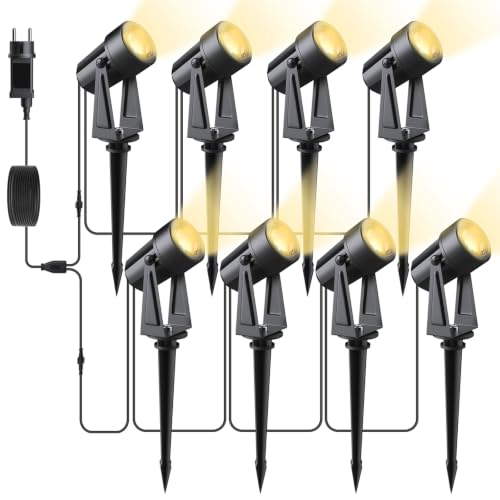
| Svater garden spotlight 8-piece set with 29 metre cable string | Svater | for accent lighting on trees, beds and walls within reach of an existing outdoor socket, not as path lighting and not as a replacement for a permanent garden cable | Read the analysis |
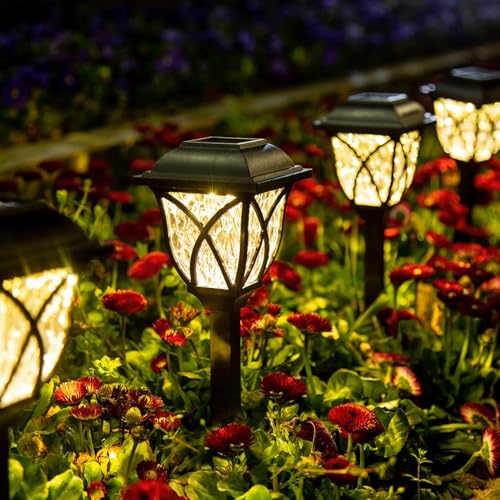
| GIGALUMI outdoor solar lights | GIGALUMI | for orientation and accents in a sunny spot | Read the analysis |
Our buying decision
INTELAMP solar floodlight YL005-10EP makes sense if you are looking for a light for short, bright bursts of light on movement on a genuinely sunny wall in the summer half of the year, have checked the dimensions at the intended spot and will actually use the functions named in the listing. The purchase is less convincing if you expect a universal solution for several conflicting lighting tasks.
Keep looking if key data such as dimensions, light output, IP rating or compatibility is not clearly documented for your intended use. The same applies if you only like the look of the design, but the cable, the floor space or the controls would get in your way in daily use.
We deliberately award no stars. A numerical score would suggest a measurement accuracy that does not exist without documented hands-on testing. The statement this page can support is narrower: which details are available, what the model may be suited for, and which questions remain open before you buy?
Frequently asked questions about the home light
Are the 3,000 lumens realistic?
The attribute table gives 3,000 lumens at 12 watts, which is 250 lumens per watt, and the highest energy efficiency class A of Regulation (EU) 2019/2015 only starts at 210 lumens per watt. A solar floodlight in an ABS housing at 6,500 kelvin would therefore have to be more efficient than any registered lamp. The manufacturer's manual speaks of a true peak output of 3,000 lumens, but the EU product register has not a single entry for the brand, so there is no independently verified figure either. It is safer to plan the area using a fraction of this claim.
How long does the device really light up in one night?
The energy store is fixed: 12,000 milliamp hours times 3.2 volts divided by 1,000 gives 38.4 watt hours. At the 12 watts stated by the supplier, that lasts 3.2 hours at full brightness; with a more realistic assumption of 100 lumens per watt, and therefore around 30 watts for 3,000 lumens, it is about 1.3 hours. Both apply only with a full battery, and in the winter half of the year the battery does not get full on many days. You only reach the promised 40 hours at the weakest continuous light setting, and even there the calculation does not work out with 400 lumens.
Is there enough sun in Germany for this device?
In the summer half of the year yes, in the winter half only to a limited extent. According to the manual the panel has a rated output of 13 watts, and the German Weather Service (DWD) gives a 30-year average of 1,086 kilowatt hours of global radiation per square metre per year for Germany, that is just under 3 full-load hours a day on annual average and around 6.6 in June. The panel therefore charges more than one battery charge a day in summer, about one on annual average, and clearly less in the dark months. For such periods the manufacturer's own manual recommends using only the short motion mode.
Is IP65 waterproof?
No. The first digit 6 means dust-tight, the second digit 5 means protection against water jets, and waterproof in the sense of temporary immersion would only be a 7 in second place. For rain, snow and a garden hose from a normal distance, IP65 is enough. Not covered is mounting so low that water can collect around the housing, and the plug connection between panel and light belongs in a spot where it does not sit permanently in the wet.
Is there a manufacturer document for this model?
Yes, exceptionally two. The brand runs its own shop at intelamp.com with a collection page for instruction manuals, and there is a manual for model YL005-10EP, which corresponds to model number DE-005-10E in the listing table. These documents do, however, contradict the German listing page several times, for example on the number of LEDs with 210 instead of 170 and on panel efficiency with 24 instead of 22.5 per cent. The brand is not in the EU product register EPREL, which is not required for a battery-powered light anyway.
Why does the motion sensor have its own housing?
Because it is meant to be mounted separately: the sensor sits where movement occurs, the light where light is needed, and the solar panel where the sun is. The manual specifies a distance of at most 30 metres between the sensor and the nearest light. Important and not mentioned in the listing: the sensor unit also has its own small solar panel and its own battery, so it needs daylight itself. If the sensor sits in the shade of a hedge, triggering fails even though the light is fully charged.
Sources and currency
The sources are ranked by their closeness to the product: manufacturer documents come before retailer or comparison data. A shop listing is useful for the variant currently on offer, but it is not an independent check. Missing documents are not replaced with invented experiences.
- Listing page for ASIN B0C936DKZ5 with all the figures that only the supplier gives: 12,000 milliamp hours, 3,000 lumens, solar panel with 22.5 per cent conversion rate, full charge in 5 hours, 4 hours at over 2,000 lumens, 400 lumens continuous light over 1,000 square feet, up to 40 hours run time, motion detection within a radius of 100 feet, delay 30 seconds, 3 minutes or 10 minutes, rated lifetime over 5 years. The attribute table gives voltage 3.2 volts DC, power 12 watts, light output 3,000 lumens, 6,500 kelvin, IP65, 170 light sources, dimensions 23.6 by 19.3 by 4.5 centimetres, model number DE-005-10E, manufacturer intelamp EU, country of origin China. In the field for energy efficiency class of light sources, the value 250 lumens per watt appears instead of a class, under bulb cap it says E26 and under room type it says children's room, bedroom and living room. A section of the image gallery gives advance triggering within 25 metres. Rating 4.3 out of 5 from 358 ratings with 74 per cent five stars and 11 per cent one star. Amazon listing B0C936DKZ5, not linked
- Manufacturer manual from intelamp for model YL005-10EP, which corresponds to the listing's model number DE-005-10E. It states verbatim that the device has a highly efficient monocrystalline solar panel with 13 watts and a 12,000 mAh lithium iron phosphate battery for a true peak output of 3,000 lumens. The motion sensor is a separate unit with its own small solar panel and its own battery, which must be mounted within 30 metres of the nearest light; within these 30 metres the lights trigger one another. The manual gives 5 hours of direct sun for a full charge and, for longer rainy, foggy or winter periods, expressly recommends setting the device only to bright motion mode and then switching it off completely. The contact address is an email address at intelamp.cn.
- Product page for the same model in the manufacturer shop intelamp.com. It gives 3,000 lumens, 210 LEDs, 6,500 kelvin, lithium iron phosphate battery with 12,000 milliamp hours at 3.2 volts, monocrystalline panel with 24 per cent efficiency, IP65, housing made of recycled ABS, weight 2.70 kilograms, detection range up to 26 feet, pairing range 100 feet, cable 16.4 feet, 3 year guarantee. The number of LEDs and the panel efficiency differ from the details on the German listing page, which gives 170 light sources and 22.5 per cent.
- Collection page with the instruction manuals from intelamp. It holds fourteen manuals for individual model numbers, including YL005-10EP. The page shows that the brand maintains its own, resolving domain with legal notice details, guarantee terms and documents, unlike many marketplace brands in the same product group.
- Radiation report of the German Weather Service (DWD) for the year 2023. According to it, the 30-year average of global radiation in Germany for the period 1991 to 2020 is exactly 1,086 kilowatt hours per square metre per year, and the decade average for 2011 to 2020 is 1,114. Radiation gain rises over the year up to June and then falls; June 2023 alone reached 199 kilowatt hours per square metre, September 124. The lowest-radiation years since 1983 were 1987 with 950 and 1984 with 970 kilowatt hours per square metre.
- licht.de on the energy efficiency classes of light sources in force since 1 September 2021, with the class boundaries for luminous efficacy: A from 210 lumens per watt, B from 185 to 209, C from 160 to 184, D from 135 to 159, E from 110 to 134, F from 85 to 109 and G below 85 lumens per watt. This documents that the 250 lumens per watt stated in the listing would lie above the highest class of the regulation.
- Händlerbund on the labelling of light sources: battery and rechargeable lamps, for example torches, fall under the exemptions in Annex III of Regulation (EU) 2019/2020 and therefore do not need to be labelled. Built-in lamps, by contrast, must be labelled together with the product around them as a single light source.
- Home page of the EU product register EPREL. A query of the light source interface for the supplier or brand name INTELAMP and intelamp on 26 August 2026 returns zero hits. So there is no registered light source for this brand, and therefore no lumen, watt or class figure checked by an authority.
- licht.de on the IP ratings of luminaires: the IP code consists of two digits, the first describing protection against solid objects and contact, the second protection against water. IP 65 stands there for dust-tight and protected against water jets.
- Overview of the IP ratings under BS EN 60529 and ISO 20653 with the table of the second digit: 4 splashing water, 5 water jets, 6 powerful water jets and flooding, 7 immersion, 8 submersion. This shows that waterproof only applies from second digit 7, and IP65 does not reach that level.
- Amazon product listing B0C936DKZ5; product data via the Creators API, retrieved 26 August 2026 Advertisement
Content checked on 26 August 2026. Prices, availability and product variants may change independently of this page. For the final check, always use the current retailer listing and any manufacturer documents.
If a linked source is no longer reachable, or the model on offer visibly differs from the product image and designation, this analysis is no longer the right basis for a decision. In that case the current model number is what counts. Tell us about the difference via the contact page (in German), so that the data, the link and the recommendation can be checked.