Does the model suit your lighting task?
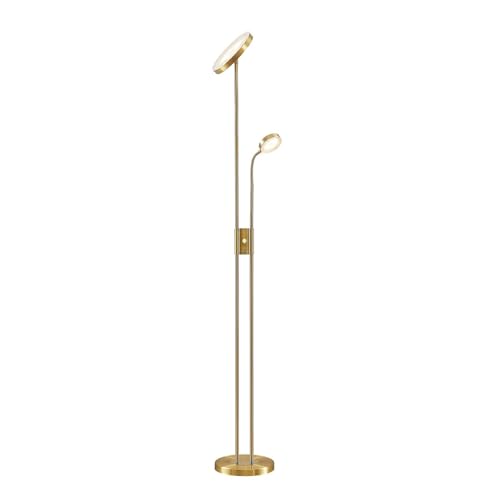
Lindby Seppa LED uplighter, round, stands in this selection for indirect background light with an additional reading light for the sofa corner. It is not intended for a later change of colour temperature or light bulb. That is a narrower and more honest statement than a blanket “good” or “bad”. A lamp can be technically sound and still disappoint in the wrong place. That is why this review starts with the intended use, not with a score.
A floor lamp always works together with its position. Next to an armchair a directed head can make sense, in a dark corner indirect light on the wall or ceiling often feels calmer. In the middle of the room, by contrast, it quickly becomes obvious whether the base, cable and shade get in the way in daily use.
For this model, 4 readable product features are available from the Amazon listing. They are not presented as independently confirmed measured values. We separate explicitly between what the source states and our practical assessment. We do not claim any long-term, laboratory or room trial of our own. We reproduce the quoted listing texts unchanged in content, but apply the house punctuation: dashes become a colon or comma, ranges of values are written out with “to”, and special characters and promotional symbols are removed. Numbers, units and statements remain untouched.
Product data and sources
| Product | Lindby Seppa LED uplighter, round |
|---|---|
| Brand | Lindby |
| Category | Floor lamps |
| ASIN | B09X1N95Z4 |
| Sources as of | 26 August 2026 |
| Type of research | Data and source analysis; no laboratory or long-term trial of our own |
Listing statement: Save electricity with this LED lamp!, The modern LED…
What the source says: Save electricity with this LED lamp!, The modern LED lamp lets you light your home (for example living room, dining room, bedroom, kitchen, hallway) or office with pleasant light in an energy-saving and energy-efficient way.
Why this matters: This statement describes a product property but does not yet answer whether it is practical for indirect background light with an additional reading light for the sofa corner. What matters is the link to the planned location. With 33 watts of connected load this lamp is not an energy-saving lamp but, by today's standards, a powerful one. For comparison: 33 watts is more than three strong LED bulbs in a ceiling light draw together. The output is right, since 2,680 lumens really do leave the lamp, but the sum only works out if you also need the light. With three hours of operation a day at full level, 33 watts add up to about 36 kilowatt hours a year.
Listing statement: Dimmer included
What the source says: Dimmer included: The lamp can be dimmed to suit you and so creates a cosy atmosphere to feel good in.
Why this matters: Dimmable is only a usable statement once the method of operation and the steps are clear. With a permanently installed LED, the electronics in the device alone decide; an upstream wall dimmer is neither necessary nor intended here. Dimming is done via two switches on the product, which according to the manufacturer page are also the dimmers, one for the large uplighter and one for the small reading light. There is no remote control, app or wall control, and the switches sit on the stem of the lamp, so you have to get up to adjust it. An external dimmer in the supply cable is neither necessary nor intended for a lamp with its own power adaptor. How finely the brightness can be graded and whether there is a minimum brightness is not said by either of the two sources.
Listing statement: Switch included
What the source says: Switch included: This lamp is fitted with a switch for switching the lamp on & off as you wish.
Why this matters: For the assessment, what counts is whether this feature brings a concrete benefit in everyday use. Without a matching lighting task it remains mainly a data sheet point. It is not one switch but two, and that is the more important point here. According to the manufacturer the uplighter and the reading light are switched separately and dimmed separately, so you can run the small 6 watt reading light on its own. Both switches sit on the product, not in the cable and not at the base. Anyone who wants to switch while seated should check beforehand whether they can reach the switch point on the stem from the sofa.
Listing statement: Light bulb included
What the source says: Light bulb included: With this lamp we supply high-quality light bulbs for your lamp, so the lamp can be used as lighting straight away.
Why this matters: This statement describes a product property but does not yet answer whether it is practical for indirect background light with an additional reading light for the sofa corner. What matters is the link to the planned location. This text block appears in the same form on very many lamps from the same supplier and is misleading here. No light bulb is supplied for you to insert; instead, according to the manufacturer page the LED modules are permanently installed, and in the attribute table the row for replaceable light bulb has the value by a specialist. The brand's assembly instructions contain the warning for light sources that are not intended to be replaced by the user. So what you buy here is a fixed colour temperature of 3000 kelvin and not a replaceable light bulb.
Use in daily life
For the general lighting of a whole living room, a single point of light is seldom enough. That also applies to bright uplighters. Good home lighting spreads several tasks: orientation, reading, conversation and accent lighting do not have to come from the same lamp.
For this model, the purchase decision should therefore hinge on a concrete situation. Before buying, write a sentence such as: “I need light for …” and add place, time of day and activity. If the model does not clearly fulfil this task, an alternative from the same category is probably the better choice.
Before buying, a simple trial in the evening is worthwhile. Switch on only the existing ceiling light and mark the spot where you lack light. Only then can you judge whether an arc lamp, an uplighter, a reading lamp or a pure accent light is the right design.
Strengths and limits of the assessment
What speaks for the model
- Product image, ASIN and listing data are clearly linked to one another.
- The design can be matched to a specific lighting task: for indirect background light with an additional reading light for the sofa corner, not for a later change of colour temperature or light bulb.
- The available features allow a targeted check before buying, without inventing a star rating.
What remains open
- No long-term use of our own, no light measurement and no documented load check.
- Listing details can be abbreviated or change with variants and model updates.
- Room effect, glare and ease of use depend on your location and daily routine.
This purchase rarely fails on the technology and mostly on the lock-in. The LED modules are permanently installed, the colour temperature is unchangeable at 3000 kelvin, and if a module fails after some years, that is not a case for a new bulb but for a qualified person or for disposing of the whole lamp. The second disappointment is the brightness, if you have the 3,600 lumens from the advertising in mind: according to the manufacturer only 2,680 lumens come out of the lamp, and because the main light works indirectly via the ceiling, a room with a dark ceiling looks clearly darker than the figure suggests. And the 190 centimetre cable with plug-in power adaptor forces the lamp closer to the socket than the nicest spot in the room would be.
What you should measure and check before buying
Measure the ceiling height and look at the ceiling colour, because with an uplighter the ceiling decides how much of the 2,680 lumens arrives below. A white smooth ceiling at 2.50 metres gives back clearly more than a dark wooden ceiling at 3.20 metres. Then measure the footprint: 180 centimetres in height and 4.94 kilograms in weight need a spot where nobody brushes past, and the large shade has a diameter of 22.2 centimetres. Also measure the distance to the socket, because the 190 centimetre cable is short for a sofa corner and a plug-in power adaptor sits at the end that needs room in the power strip. And check while seated whether you can reach the two switches on the stem, because there is no remote control.
- Define the task: Write down which surface or zone is to be lit and at what time of day you use it.
- Measure the space: Check the standing or mounting surface, height, cable route and reachable socket. Product photos are no substitute for measurements.
- Compare the light data: Check light output, colour temperature, dimming and, if needed, IP rating in the current listing or manual.
- Think through the controls: The switch, app, sensor or remote control must be reachable and understandable in daily use at the planned location.
- Check the variant: Colour, size and set contents can differ within one listing, and often the technical details in the description text with them. Compare the selected variant with this analysis.
If you are unsure how much light your room needs at all, work it out once: the lumens-to-watts chart translates wattage figures into actual brightness, and how many lumens per room you need depends on floor area and activity. More models from this area are in the overview under floor lamps, and the lighting calculator turns your room into a concrete target brightness.
Set-up, position and first check
First place the lamp at the intended spot without an extension lead. Align the light head while seated, check for reflections in the television and check whether the switch is within reach. The light source is built in: lamp holder, choice of light bulb and dimmer compatibility do not apply, and instead the built-in control decides brightness and colour temperature.
After set-up, do not judge the light only in daylight. In the evening, switch the rest of the lighting as you normally use it, and check the situation from seated, standing and walking height. Only then do disturbing reflections, hard shadows or an unfavourable switch position become visible.
Keep the manual and model designation. This helps with spare parts, with a later query about the product and in a guarantee claim. Replacing the light source is not intended; at the end of its lifetime the whole device is replaced.
Comparison with similar models
The comparison does not name winners. It shows models of the same category so that you can see whether one of them is closer to your lighting task. If two models have the same task in the Assessment column, they do not differ in purpose but in design, dimensions and features. The column then states what is actually different according to the sources.
| Model | Brand | Assessment | Details |
|---|---|---|---|
| Lindby Seppa LED uplighter, round | Lindby | for indirect general light with an additional reading light at the sofa corner, not for changing the colour temperature or light bulb later | This review |
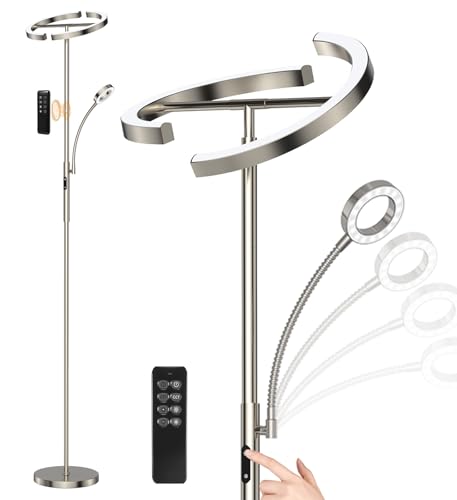
| ANTENLICHT KAKA floor lamp silver | ANTENLICHT | for indirect living room light with separately switchable reading light, not for buyers with fixed expectations of brightness and height | Read the review |
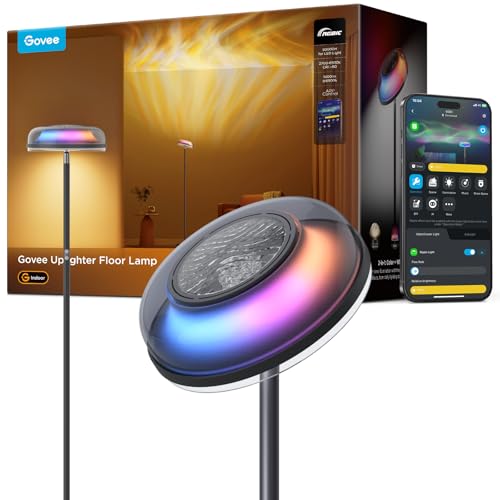
| Govee uplighter wave lighting RGBICWW | Govee | for indirect zone lighting with a moving projection on wall and ceiling | Read the review |
Our buying decision
Lindby Seppa LED uplighter, round, makes sense if you are looking for a lamp for indirect background light with an additional reading light for the sofa corner, have checked the dimensions at the intended location and will actually use the functions named in the listing. The purchase is less convincing if you expect a universal solution for several conflicting lighting tasks.
Keep looking if key data such as dimensions, light output, IP rating or compatibility is not clearly documented for your intended use. The same applies if you only like the look of the design, but the cable, the floor space or the controls would get in your way in daily use.
We deliberately award no stars. A numerical score would suggest a measurement accuracy that does not exist without documented hands-on testing. The statement this page can support is narrower: which details are available, what the model may be suited for, and which questions remain open before you buy?
Frequently asked questions about the floor lamp
Can I change the light bulb?
No, at least not yourself. The manufacturer states on the product page that the LED modules are permanently installed, and enters the value by a specialist in the attribute row for replaceable light bulb. The assembly instructions also contain the warning for light sources that are not intended to be replaced by the user. With the purchase you therefore commit permanently to 3000 kelvin warm white.
How bright is the lamp really?
The manufacturer gives two figures, and only the second counts for your room: 3,600 lumens for all light bulbs together and 2,680 lumens for the lamp. The difference of 920 lumens, or 25.6 per cent, stays in the shades. For room planning, therefore, count on 2,680 lumens, split between a large uplighter and a small 6 watt reading light. Because the main light works indirectly via the ceiling, even less of that arrives below, depending on ceiling height and wall colour.
Is energy efficiency class E correct?
Yes, but only after a correction that the listing does not mention. From 3,600 lumens and 33 watts you get 109.09 lumens per watt, and under Regulation (EU) 2019/2015 that would still be class F, because E only starts at 110 lumens per watt. The modules hang on a plug-in power adaptor and so do not run directly from the mains, which is why the factor 0.926 from Annex II is applied to the luminous efficacy: 109.09 times 0.926 is 101.0 lumens per watt, which is class F. The advertised class E cannot be reproduced this way. At your electricity meter, 33 watts are still what counts.
How is the lamp operated?
Via two switches on the product that also act as dimmers, one for the uplighter and one for the reading light. There is no remote control, app or colour temperature control, and the colour is fixed at 3000 kelvin. Both lights can be operated separately, so in the evening you can leave on just the small 6 watt reading light. Before positioning it, check whether you can reach the switches on the stem from your seat.
Do I need a qualified electrician for the connection?
No. According to the manufacturer the lamp has a type C Europlug and a plug-in power adaptor, so you plug it into a normal socket. The assembly instructions require a qualified person only in two cases: when damaged cables have to be replaced and when the lamp is taken apart to reach the light source. For the assembly itself, the enclosed instructions are enough.
Can I find the lamp in the EU product database?
As a buyer, practically not. Neither the listing nor the manufacturer page gives an EPREL number, and the manufacturer page does not even show an energy efficiency class for this article. Lindby registers its permanently installed modules under its own identifiers of the form L9003, for example registration 748663 with 2,650 lumens at 22 watts and class E, not under the article number of the lamp. Without the module identifier, which is not published anywhere, a search in the register leads nowhere.
Sources and currency
The sources are ranked by their closeness to the product: manufacturer documents come before retailer or comparison data. A shop listing is useful for the variant currently on offer, but it is not an independent check. Missing documents are not replaced with invented experiences.
- Listing page for ASIN B09X1N95Z4 with the supplier's details: LED floor lamp Seppa, two-light, gold or brass, metal, dimmable, dimmer included, switch included, light bulb included. Also the mandatory note that this is a containing product, that is a lamp that can be taken apart to check the contained light sources separately, and that the product contains a light source of energy efficiency class E. A height, a wattage, a lumen figure and a kelvin figure do not appear in the listing. Amazon listing B09X1N95Z4, not linked
- Product page of Luqom Holding GmbH, the owner of the Lindby brand, for article number 9945422, Seppa round in matt brass. It gives the full values: height 180 centimetres, large shade 22.2 centimetres, small shade 10 centimetres, cable length 190 centimetres, net weight 4.94 kilograms, material metal and glass, light bulbs 1 x 27 watts LED and 1 x 6 watts LED, total power 33 watts, colour temperature 3000 kelvin warm white, brightness of all light bulbs 3,600 lumens, brightness of the lamp 2,680 lumens, IP rating IP20, Class II, connection voltage 230 volts, mains plug type C as a Europlug power adaptor. Also explicitly noted are the statement that the LED modules are permanently installed and the row for replaceable light bulb by a specialist. The page gives no energy efficiency class and no EPREL number.
- Assembly instructions from Lindby for article number 9945422, revision 3.0, issued by LUQOM Holding GmbH, Rabanusstraße 14-16, 36037 Fulda. They contain the declaration of conformity under BS EN 60598 (EN 60598 in the original document) and the EU directives 2014/35/EU and 2014/30/EU as well as the explicit warning for light sources that are not intended to be replaced by the user. According to the instructions the electrical connection may only be made with specialist knowledge, and damaged cables may only be replaced by a qualified electrician.
- EU product database EPREL, registration 748663 of the Lindby brand, model identifier L9003461, entered via LUQOM HOLDING GMBH. Registered are 2,650 lumens at 22 watts, energy efficiency class E, 3000 kelvin, and NMLS is entered as the mains connection, that is a light source that is not operated directly from the mains. The entry shows how Lindby registers its permanently installed modules: under its own identifiers of the form L9003 and not under the article number of the lamp. A registration under article number 9945422 or under the model name Seppa does not exist.
- licht.de on the energy efficiency classes of light sources that have applied since 1 September 2021, with the class limits of luminous efficacy: A from 210 lumens per watt, B from 185 to 209, C from 160 to 184, D from 135 to 159, E from 110 to 134, F from 85 to 109 and G below 85 lumens per watt.
- German Environment Agency (Umweltbundesamt) on the energy consumption labelling of lamps and luminaires. It names Regulation (EU) 2019/2015, which since 1 September 2021 has set the classification from A to G for light sources and under which the luminous efficacy of light sources with a separate control gear is corrected by the factor 0.926.
- Amazon product listing B09X1N95Z4; product data via the Creators API, retrieved 26 August 2026 Advertisement
Content checked on 26 August 2026. Prices, availability and product variants may change independently of this page. For the final check, always use the current retailer listing and any manufacturer documents.
If a linked source is no longer reachable, or the model on offer visibly differs from the product image and designation, this analysis is no longer the right basis for a decision. In that case the current model number is what counts. Tell us about the difference via the contact page (in German), so that the data, the link and the recommendation can be checked.